The first thing I do when I plan hallway remodel ideas 2026 is to ask what issues the space must address and how people should experience it as they take the first step through it. I also sketch the locations where small hallway remodel ideas or long hallway remodel ideas are the most successful without ripping up the entire floor plan. What would storage eliminate every day, what would light bring, what materials would support daily use, and what would withstand traffic and get old gracefully. And which way should artwork lead motion, and in what direction might a window or a mirror borrow light in an adjoining room or in a redesign of a hallway bathroom ideas refine. I inquire about how the corridor is attached to life above and below the stairwell, and how ideas of redesigning the upstairs hallway should affect finishes in the main level. All these questions help me be practical and future oriented so that the outcome will be fresh in 2026 and remain helpful way beyond that.
Hallway Remodel Ideas 2026: Transforming Transitional Spaces for the Future
I use the hallway as a mini studio of the house where there is a meeting point of light, texture and storage. I prefer in 2026 low-glare light layered lighting, natural finishes that will last, and smart details that fade when not in use. To minimize visual distortion, I intend to have an endless flooring, to introduce slight texture to the walls so that the surfaces are not in a flat plane and to employ color deliberately, so that the corridor does not appear as a by-product. Where there is a point at which I would like to pause, I incorporate slim seating or a floating console, but maintain wide walking lines. In places where there is a bath, I match metals and tile colors so that hallway bathroom redesign concepts and hallway finishes create a single design narrative. This method transforms a pass-through to a relaxing, handy yet quietly contemporary area.
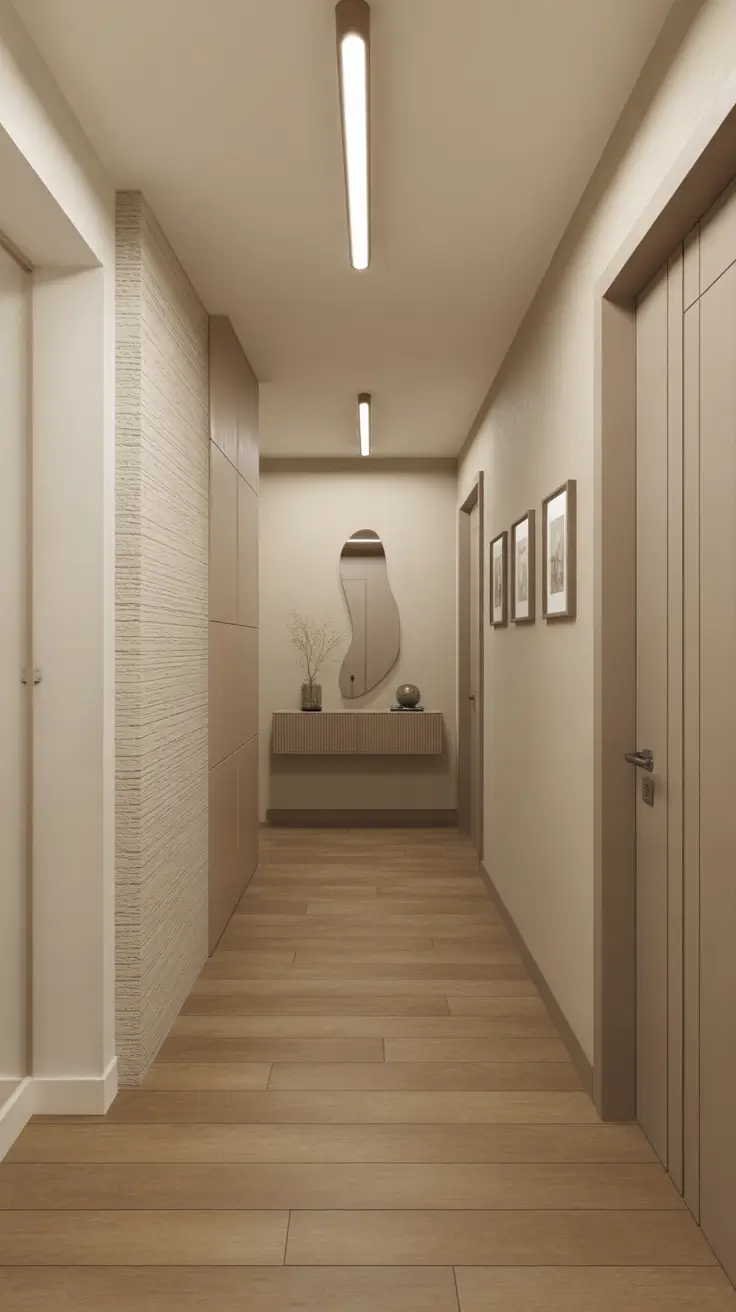
In fixtures, I use linear LED ceiling lights on dimmers, low-profile wall washer to show texture and motion activated night setting to be safe. An auxiliary wall-mounted console is a shallow, non-obtrusive item that takes in keys but does not cause the corridor to become cluttered, and a closed toe-kick prevents the build-up of dust. I prefer a runner that is tightly woven and low piled to allow doors to slide and the cleaning to be easy. Framed art objects in regular patterns produce rhythm and one sculpture mirror reflects light without screaming. Paint is made to lean matte to limit the reflection whereas doors and trim have a little higher sheen to create slight contrast and longevity.
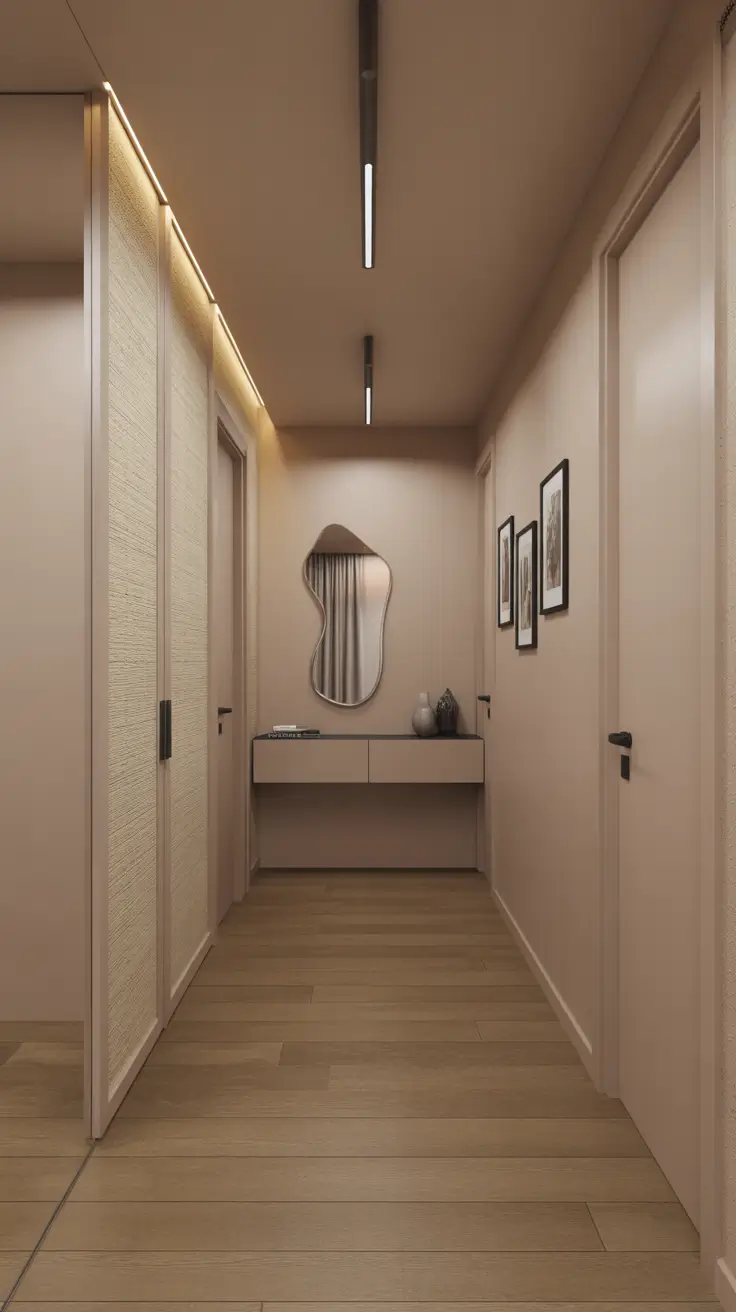
In my experience, the most significant improvement is provided by the lighting control and sightline discipline. Most designers accentuate the use of layered lights and muted colors in the circulation areas since it helps in alleviating fatigue and also assisting the eye to move around with ease. I do, and I include one of my own regulations which, to harmonize the frames and sconces, is to make them conform to a general center-line, in order that the passage be not a makeshift but a deliberate composition. I also design door hardware finishing in this area regardless of the mixing of metals in other rooms to ensure the hallway remains serene. It is much more luxurious trying to do small, repeatable motions in this case than a single loud motion.
To make this section even better, I would incorporate hidden charges within the console drawer and a thin acoustic panel behind the artwork to calm down sound. I would also replace simple switch plates with paintable screwless covers to tidy up the envelope and would want to think about a low profile ceiling speaker mounted to whole-home audio to provide a low-level background music. Lastly, I would change doorstops and thresholds such that the corridor will be well-tuned at each end.
Small Hallway Remodel Ideas That Maximize Space and Style
I make each inch work in a tight passage-way do twice its job without making the walls appear to be crowded together. My baseline is a light and warm neutral on walls, a little darker trim, and reflective yet not shiny ceiling to raise the volume. I put out swing doors with pocket doors or wider cased ones wherever possible to reclaim sightlines and clearance. I use mirrors to reflect lights rather than dark corners and I have large art few and not numerous little ones. Flooring proceeds to the other rooms in order to create a perception of a larger field in the eye and a narrow track to lead movement. The ideas of these tiny hallway remodels give it an airy touch but they also provide actual functionality.
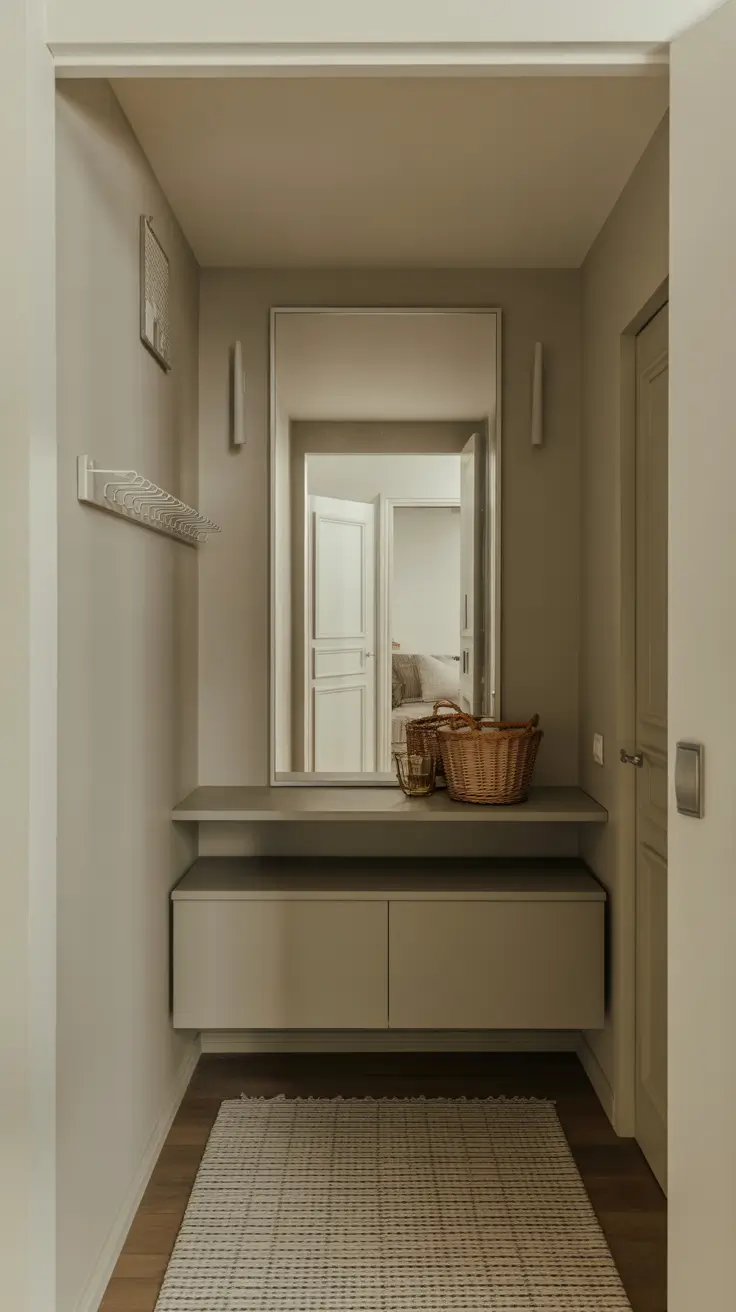
My kit essentials are a drop zone of a 10 to 12 inch deep floating shelf, a peg rail with baskets, and a closed cabinet to store messy things. I install thin pillars on walls above eye level, which opens up the wall space and a flush linear ceiling light that creates even lighting. There is a framed mirror facing a doorway to steal some sunlight and there is a striped runner to attract you. Hooks deal with the everyday coats and a bench drawer that is hidden contains the seasonal accessories. The finishes remain unchanged so that the composition is not hectic.
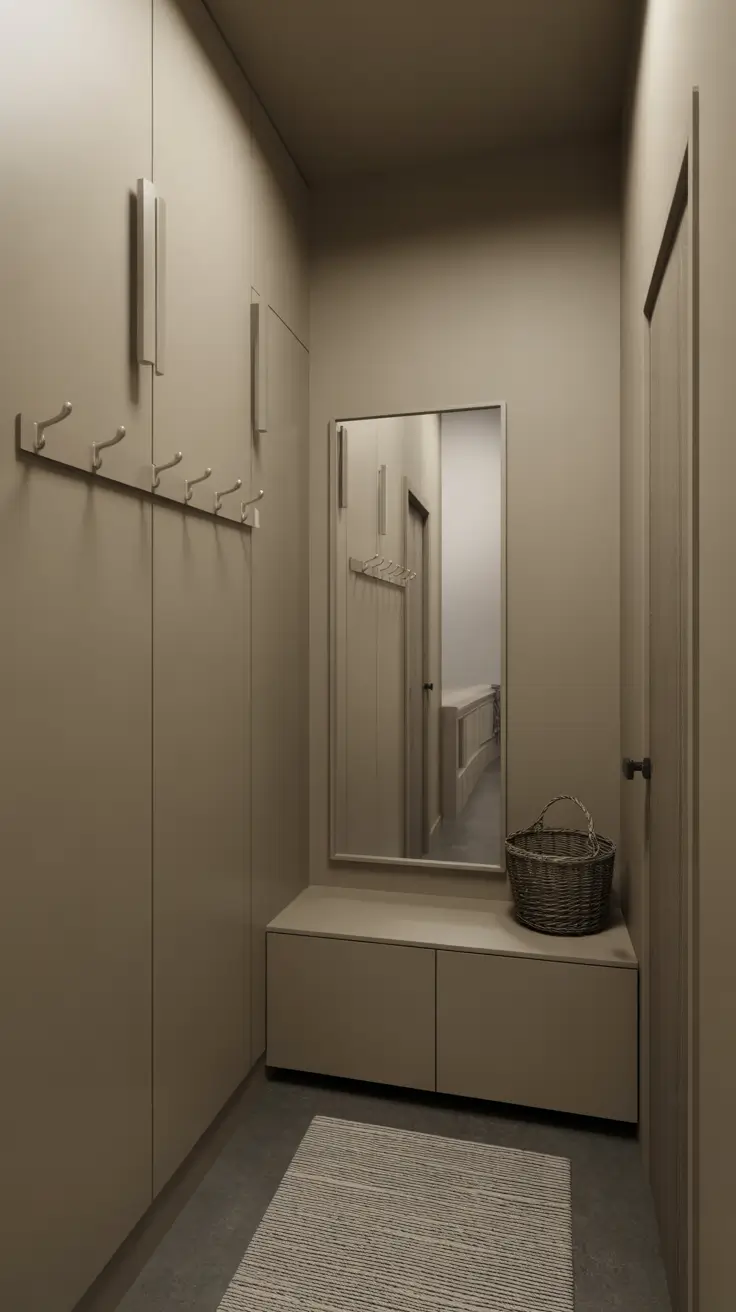
I have found out that clutter control is the actual square footage multiplier in narrow corridors. I use a limited palette and single accent, wipeable paint that will last, a metal finish you can work with when your hands are dirty with an elbow. Numerous practical guides recommend mirrors and vertical storage in small areas of the place, and that is the trick to make those aspects look aesthetically silent. The corridor is premeditated and elegant when I cut objects down to the required fragments. Adequate lighting also alleviates the feeling of squeeze.
To finish the concept, I would include a slender motion night light on the baseboard and a magnetic catch on the tiniest cabinet to remove sticking knobs. I would also incorporate shallow framed cork panel within the door of the cabinet to keep notes and have a tube with a lided umbrella by the jamb. The sensory experience is completed with a fine reed diffuser by the entrance without a visual distraction.
Long Hallway Remodel Ideas to Break Up the Monotony
Rhythm, punctuation and destination are beneficial in a long corridor. I start by splitting the length into visual chapters with lighting pools, grouping of art pieces or slight variations in wall texture. I make a center of interest at the end – a window, a niche in the sculpture or a panel with a color wash – to make the exploration meaningful. I maintain the ceiling level but will add a shallow beam or batten effect, to accentuate tempo and eliminate the bowling-alley feel. A permanent runner that has some patterns areas is used to speed up the walk. These remodel plans of the long hallway cool the length and give it some interest without cluttering it.
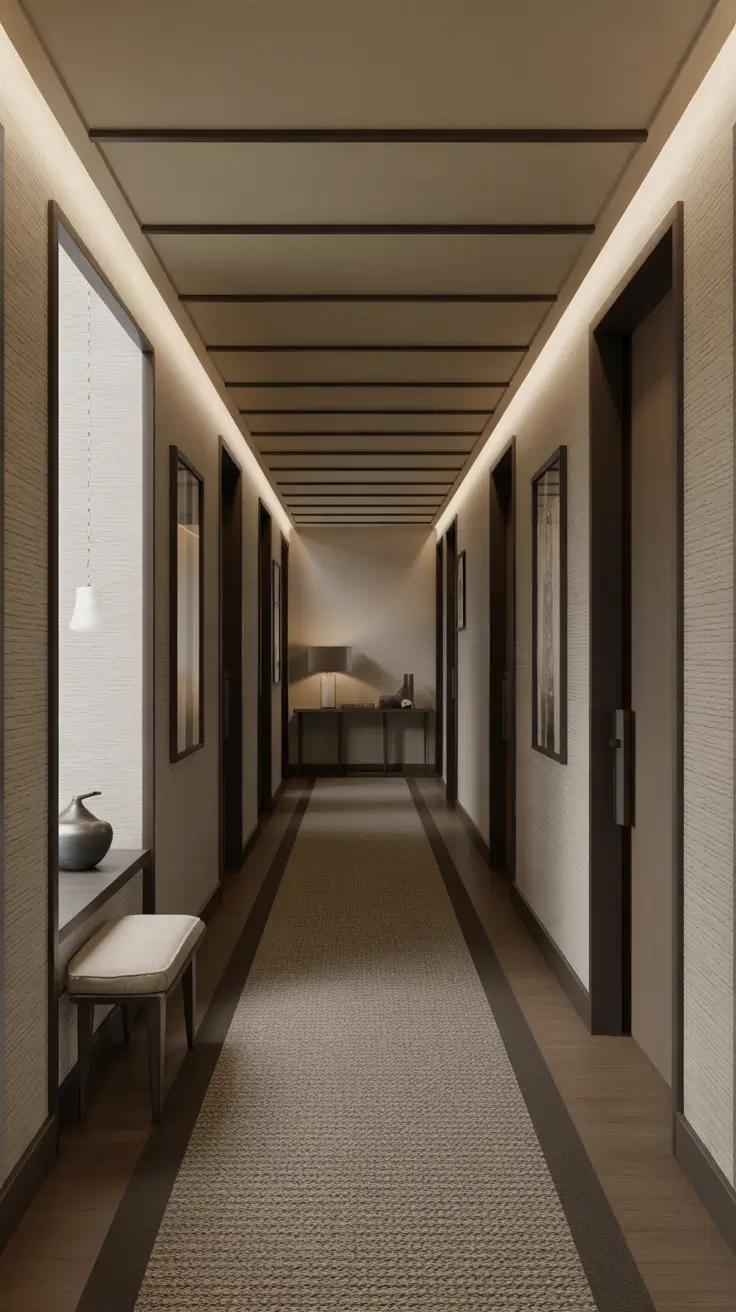
I indicate wall washers, which graze textured panels and alternate with framed pieces of proportional size to maintain cadence. In the middle, there is a recessed niche that contains a plant or vessel and indicates a stop point above a small bench. The door casings down the route are made to have a regular profile to give the line a regular look and the hinges and levers are designed to be consistent to maintain the line. Those chapter points are differentiated, and a thin picture rail can be used to curate the art flexibly. A single-statement lamp console at the terminus uses the vista as a foundation.
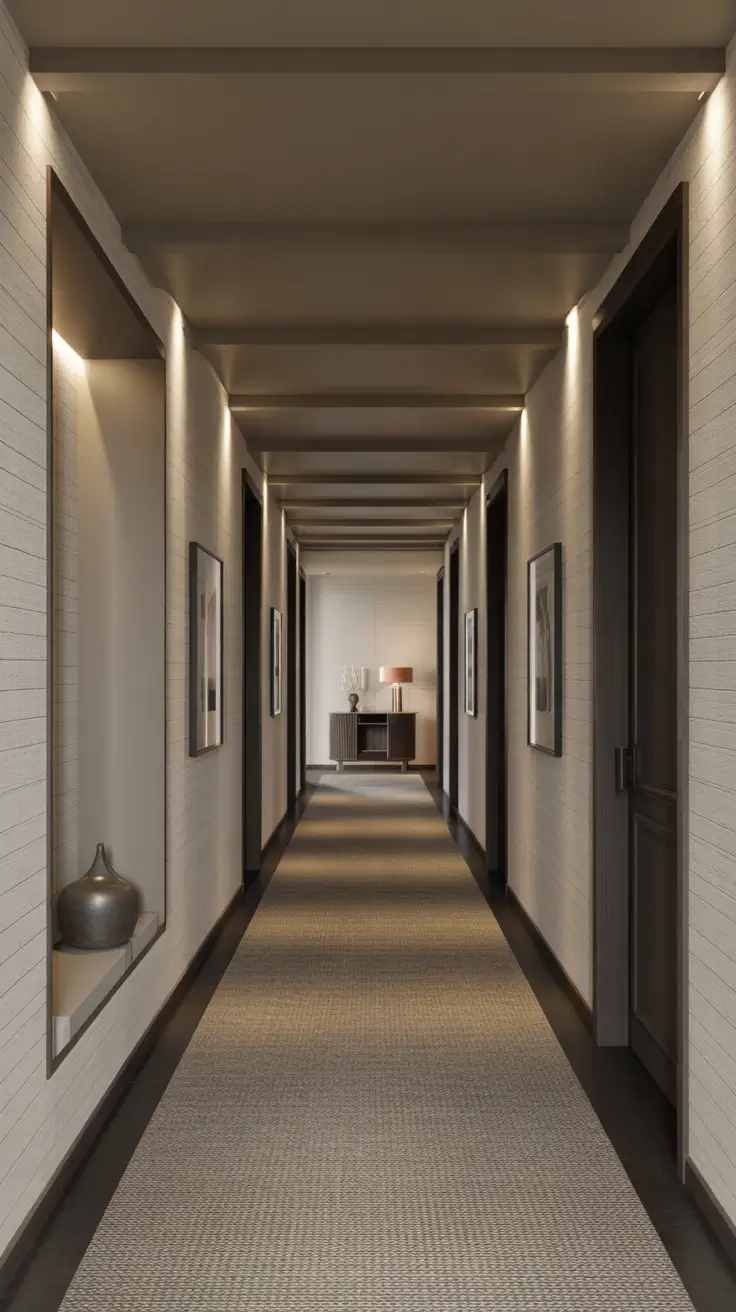
Practically, everything is in sightlines in Long corridors. I arrange artwork pivots on a datum and maintain sconce heads at the same height to minimize visual noise. Lighting in museums – diffuse, regulated glare, and uniform color temperature – come to an ideal at home. I restrict the palette to two primary colors and one accent, as well, so that the eye does not get tired of repetition. When the corridor beckons to you to move into a definite goal, it ceases to seem dead space and begins to seem part of a building.
To make this even more perfect I would include a small sitting niche with an in-built cushion as long as the width would permit and would look to changing the ceiling sheen at the half point to create a soft transition. I would change one solid door with reeded or ribbed glass to allow the passage of light and preserve privacy. Lastly, I would under-lay a lamp floor outlet that has no exposed cords under the end console.
Upstairs Hallway Remodel Ideas for Cohesive Home Design
The connection between individual rooms is made by the upstairs corridors and, therefore, I intend to be soft, safe, and quiet. I go with low-sheen paint, soothing textures, and sound-absorbing features that ensure low levels of conversation in the area around bedrooms. Instead, I would like to have warm light that is dimmable and a special night path where only movement is allowed. Where feasible, I borrow light through a skylight or solar tube or by enlarging a door to a common attic. I maintain handrails that are easy to hold on to and renovate balusters to a safer and more fashionable appearance. These are the ideas of remodeling the corridors upstairs that have connected the levels into a single serene story.
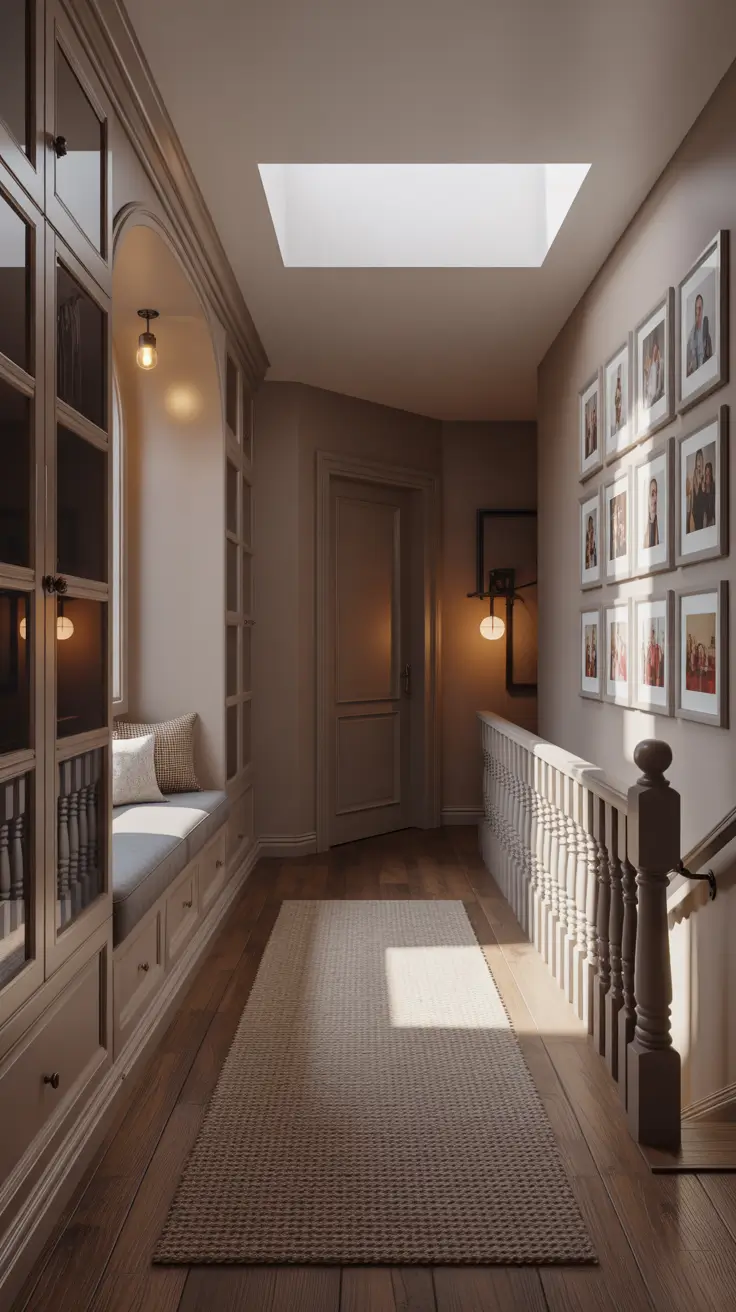
My standard design will consist of a built-in linen, closed lower drawers with glass uppers to display, a cushioned seat at a landing, and a soft runner to make the steps less noisy. I have step lights or low baseboard lights that I install with a timer so that they can act as a guide at night. The doors are updated with better seals to minimize sound transmission and easy-to-use levers suitable to various ages. The route is personalized with a gallery of family pictures in the same frames without visual noise. An intended reading corner or writing table transforms a transit into a little haven.
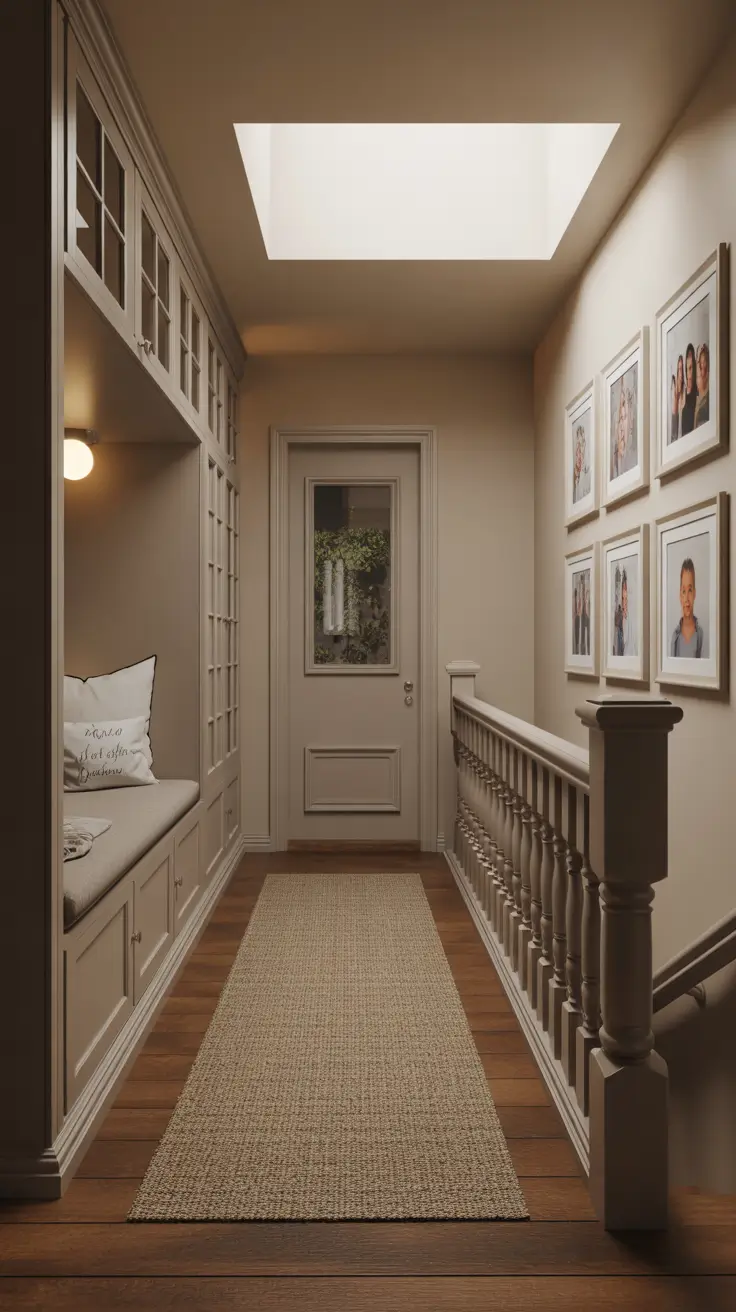
Through experience, in experience, the trim and hardware between floors is the cement of a coherent home. Stairs Safety: Stairs can also be an issue, so I check that handrail heights, baluster spacing, and clear widths are addressed when deciding on the finish. Most enthusiasts promote the use of light and sound in sleep areas, and I observe how early decisions on these issues save post hoc solutions. I also make the carpets or runners that are used in the bedrooms to match the floor so there is smooth transition. The outcome is the silent connection between rooms that fosters rest and routine.
A hidden charging drawer in the linen built-in to charge the devices in the upstairs would be incorporated to complete the concept, and a louvered panel would be added in the same cabinet to provide ventilation. I would also stipulate a soft-close system on all the doors going to the upstairs areas, that will minimize the noise at night. When the ceiling of the hall is arched a little trifle coffer ornament is enough to scale it down without enormous decoration.
Hallway Closet Remodel Ideas to Add Functionality and Elegance
Closets in a hallway are the best opportunities to upgrade the performance. My starting point is determining whether the closet should be a daily drop, a real linen vault, or a combination. I will include interior lights which will be automated and shelves which will have the size of actual porches and not imaginary ones. In the kitchen, doors should get as much attention as cabinets, and I would use paneled wood, glass with fabric backing or use reeded fronts to provide texture. I also have the exterior hardware in balance with adjacent door sets to ensure the hall is coherent. These ideas of remodeling the hallway closet can make the corridor orderly serene.
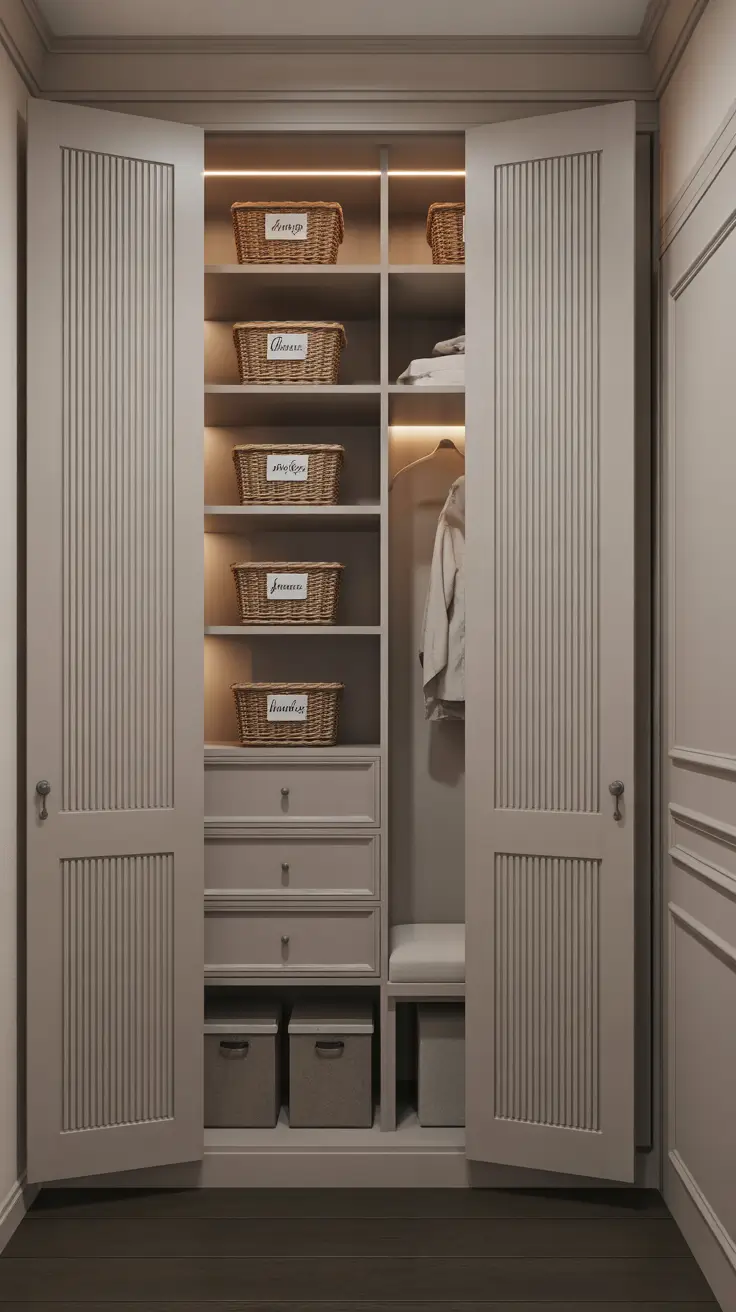
Indoors, I indicate adjustable shelves, shallow pullouts on small items and at least one tall bay on brooms or a small vacuum. I will include a low cabinet to hold guest linen, a labeled tray to hold batteries and bulbs, and a hamper with a lid in case the closet is close to bedrooms. LED strips are motion-activated and run along the face frames to provide even shadow-free light. In areas with high concentration of coats, I fit a double height hanging plan and a slim bench with a storage space at the bottom. Hooks behind a wipeable wall panel keep paint away and make them easier to maintain.
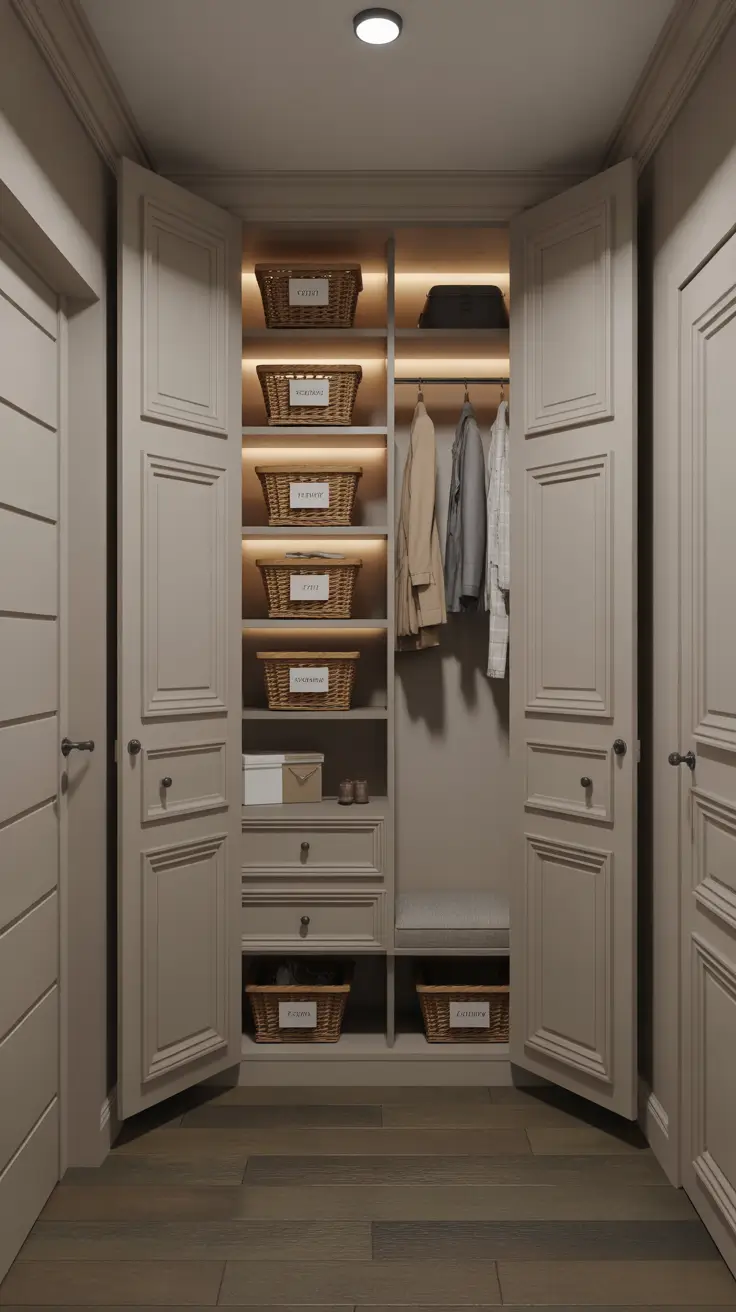
I have experienced the effect of a tuned closet on the feel and operation of a hallway in everyday life. Professional organizers suggest categorizing and labeling, and I follow that advice with stylish bins that may fit the palette of the corridors. Obvious areas are simple to make returns, which means that mess is unlikely to leak into sight. I also enjoy wearing breathable baskets on textile and closed drawers on visual silence. As the interior is as polished as the exterior, it is less stressful to open the door.
To finish the upgrade, I would install a dehumidifier puck when linens are present here, soft-close hinges to prevent the door damage, and a thin toe-kick vacuum outlet in case the hall has hard floors. I would add a shallow shelf of a cordless vacuum and a small cedar or sachet insert to keep contents fresh. In case the closet is exposed to a dark area of the hall, a decorative type of door can also form an aesthetic center of interest.
Hallway Bathroom Remodel Ideas That Merge Utility and Beauty
I begin by viewing a hall bath or powder room as a luxurious extension of the passage instead of a boxed-in space. Long stretches have a solid core pocket door that has soft-close hardware to maintain the flow of traffic as well as enhance privacy. I are matching tile patterns between the bathroom door and the hallway in such a way so that surfaces are perceived as a single field of tranquility. In the case of walls, I would use washable, waterproof paint in a mid-light shade that reflects light back to the hall. I will also consider ventilation and sound control at an early stage, since Upstairs bath doors can be close to bedrooms and require a silent mode of operation.
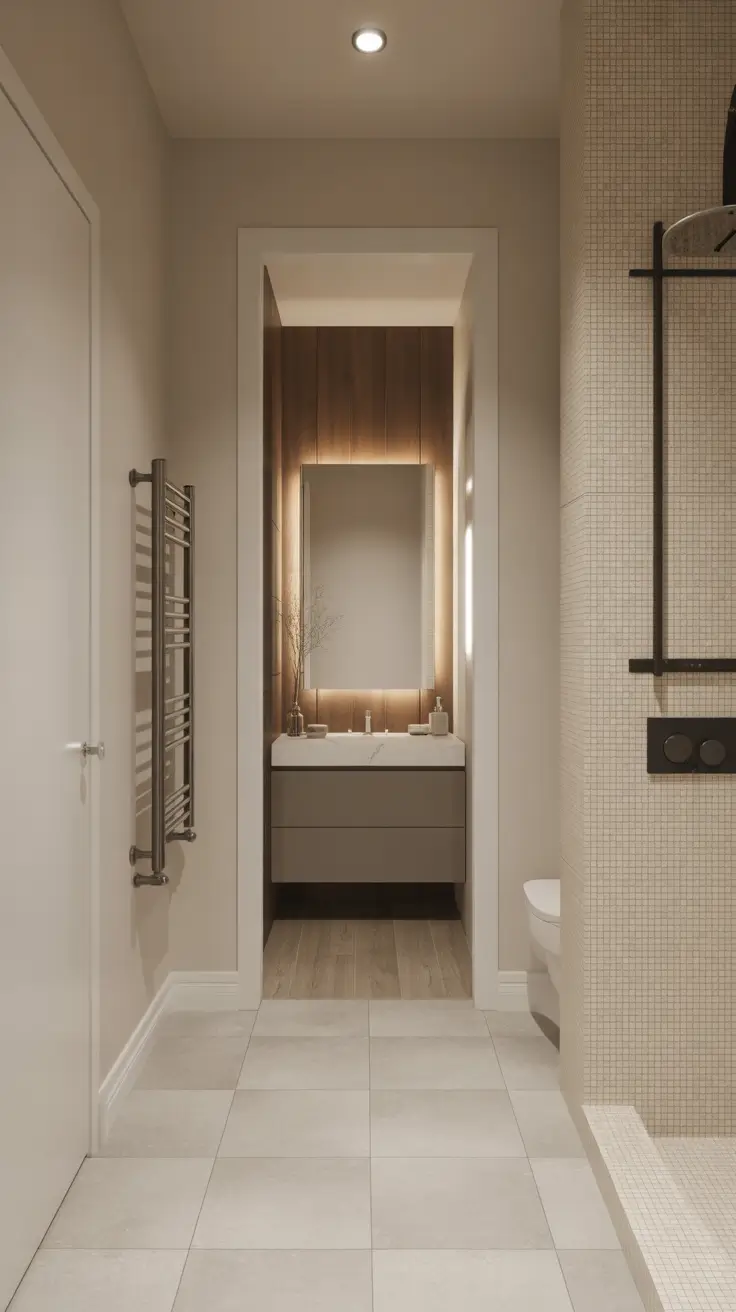
The bath includes a floating vanity of my choice, to reveal more floor and expand the room visually beyond the corridor perspective. A porcelain tile that is not too thick and has a soft texture is also something to give the floor (grip) and easy to clean, and a slim backlit mirror is something that gets rid of bulky fixtures. I combine a recessed medicine cabinet with a narrow linen niche which will look into the hallway to serve as a discreet storage. Towel warmer ladder can be used instead of several hooks and preserve textiles in a tight plan. Matte metal hardware is attached to the sets of the hallway levers in such a way that the entire run seems to have a purpose.
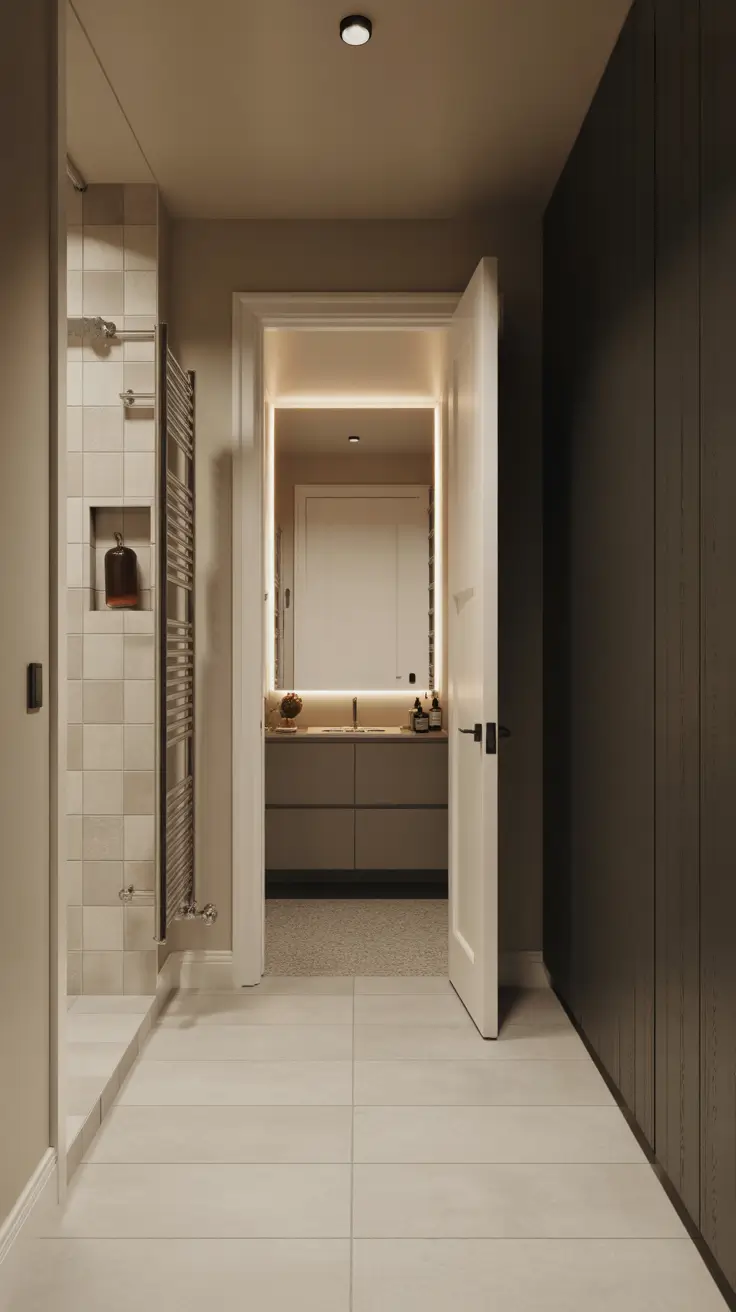
By trial and error, however, the most successful hall baths steal daylight in the corridor by means of a sandblasted transom or by means of borrowed-light panel above the door. I maintain less lighting at night but include motion-activated lighting so the guests can move around without glare. I do not use too much dark stone on the threshold as contrast lines inside the door can cause the Long hall to seem shorter. In case of a tight space, I would use a small skirted toilet due to the ease of cleaning and clearer view. Minor things such as a soft-close seat and a noiseless fan make the room seem more costly than it is.
To complete this section, I would incorporate the acoustic upgrade and privacy strategies which most projects lack. Door sweep and perimeter seals prevent noises, which is relevant particularly to Upstairs halls near bedrooms. Should the corridor require additional storage, I recess a shallow linen cabinet into the corridor with flush doors to reflect hallway closet remodel notions without impeding traffic. Lastly, I prefer to stipulate dimmable backlit mirror attached to a vacancy sensor to use nighttime easily.
Modern Hallway Remodel Concepts for 2026 Homes
In 2026, contemporary hallway remodels are cozy, warm, and peaceful high-tech. I will make the shadows and gaps at baseboards and ceilings crisp to eliminate visual clutter and make the walls look taller. Hidden hinges in flush doors create a plane that is read uninterrupted that is useful in Long layouts. Real wood, plants and textured plaster are introduced into my space to make minimal lines milder by adding biophilic elements. Presence sensors and smart dimmers can be set to automatically switch the lighting perspective between the day and evening and would be most beneficial in the corridors of the Upstairs.
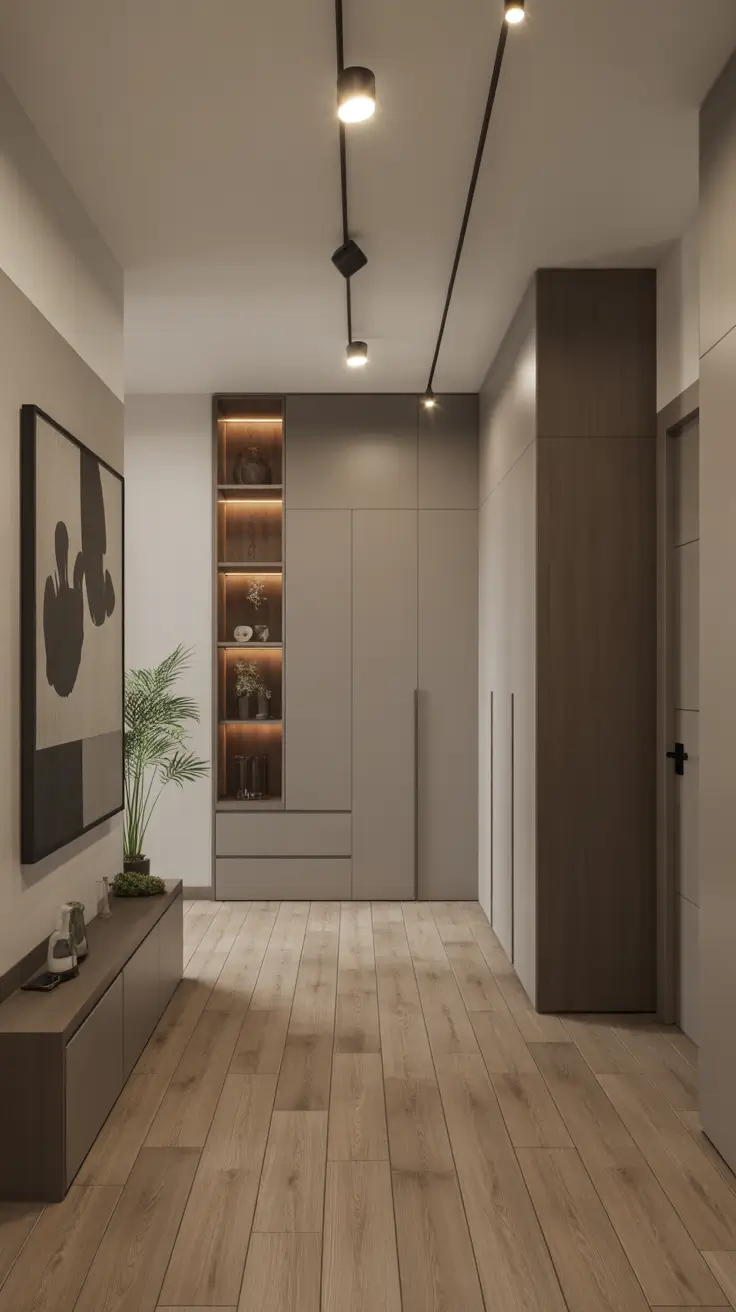
I will use broad plank engineered white oak or durable wood-look substance to have continuity with the living rooms. Micro-LEDs in built-in wall niches raise art without large fixtures, and a thin console with drawers gathers day-to-day objects. In places where storage is required, I conceal a shallow coat or utility cupboard in a flush paneled wall finish that matches the hallway closet remodel concepts. There is a bench with a cushion just outside the hall that serves as a quick stop to take off shoes and bags. In the case of hardware, I maintain the same finish on both doors and consoles to prevent visual clutter.
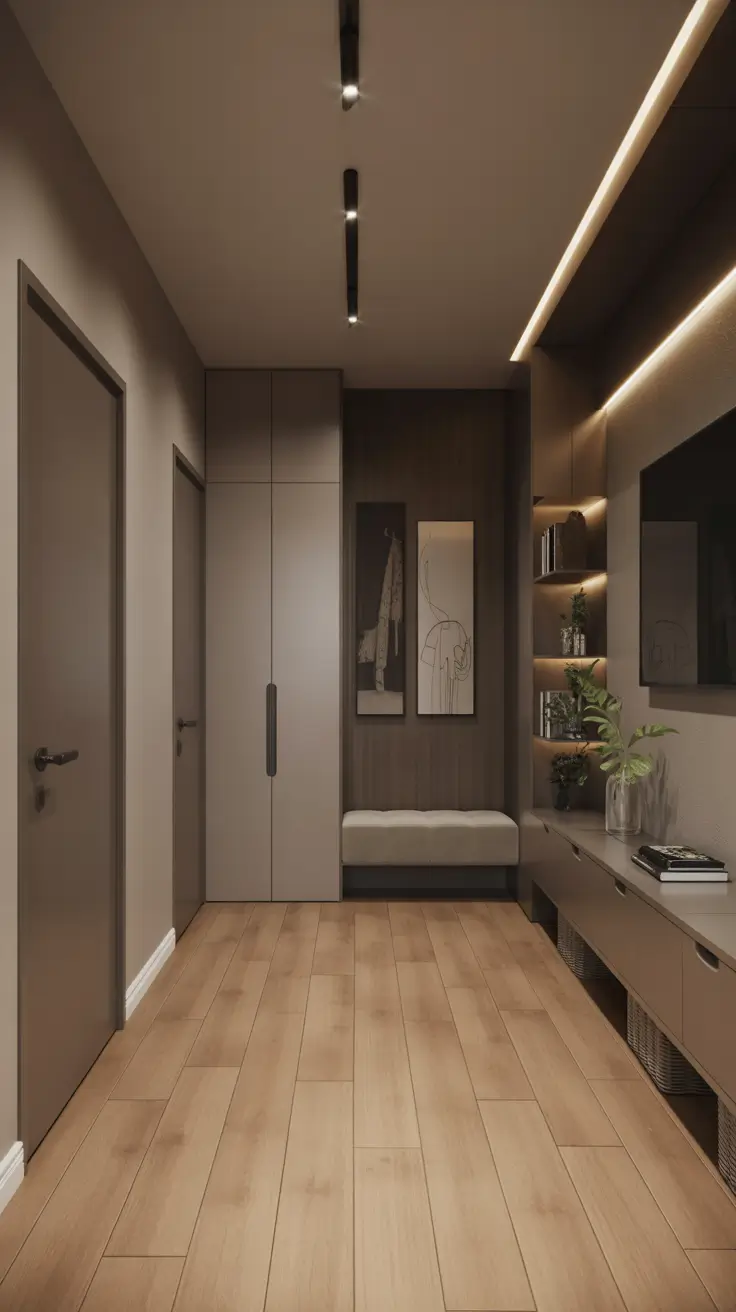
Modern does not imply stark in my practice. I prefer a subdued range of three materials at the most, then reuse them willfully at one end of the run to the other. The reason is that a small increase in white temperature post-sunset would make halls less cold and more hospitable. Painting is best read at points of natural pauses rather than at the intervals scattered along Long walls. I also install a charging ledge somewhere out of sight so gadgets are not visible and cords are not disruptive.
What I would also add is an acoustic plan more frequently, as the contemporary finishes may be echoey. Underlayment of the hall with cork or felt can reduce noise without altering the appearance without the addition of a wool runner and soft Roman shades. When the width of the point in the corridor is very wide, then think about a shallow reading niche and a built-in sconce as character. And lastly, prewire the sensors or controls that you will add in the future to avoid having to cut walls open to increase the tech layer.
Minimalist Hallway Remodel Ideas for Clean, Open Spaces
In building a minimalist hallway, I aim at visual silence and spacious negative space. I match doors, trims and outlets to a common datum to allow the eye to slide forward. The wall color tends to be white or light putty to ensure the high level of light are maintained in small hallway remodelling ideas. The materials that I use are limited to one wood color, one quiet paint color and one detail in one stone or tile, at a threshold. I do not use heavy pendants in Upstairs runs either, but instead use low profile ceiling lights that cannot be seen.
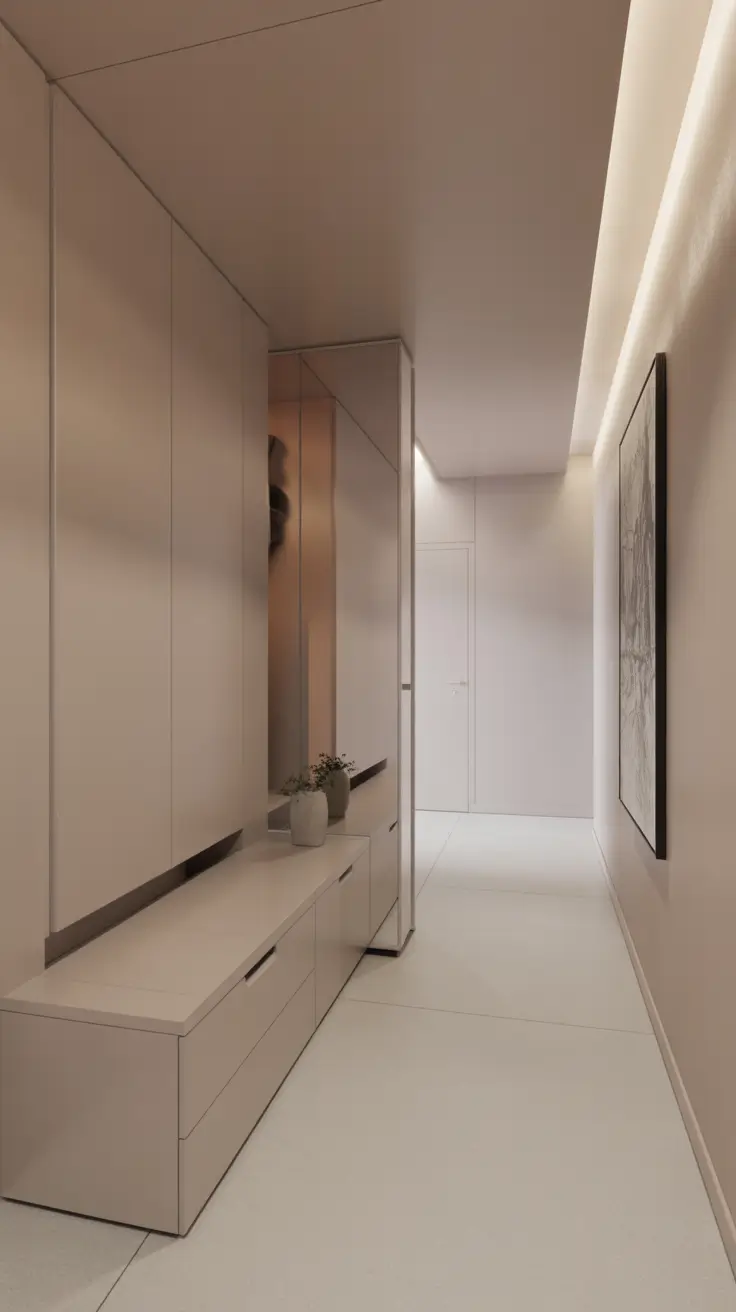
Storage and furniture are not added, but built in. I prefer deep, floor-to-ceiling cabinets with fronts that open by pushing, even protruding to the wall plane, which is directly inspired by the ideas of remodeled closets in hallways. One end has a slim bench with drawers that are concealed without cluttering the flow. An intersection frame-free tall mirror is twice the perceived width and reflects light. Cove lighting on one sidewall is linear, which produces a soft wash without glare but stressing length.
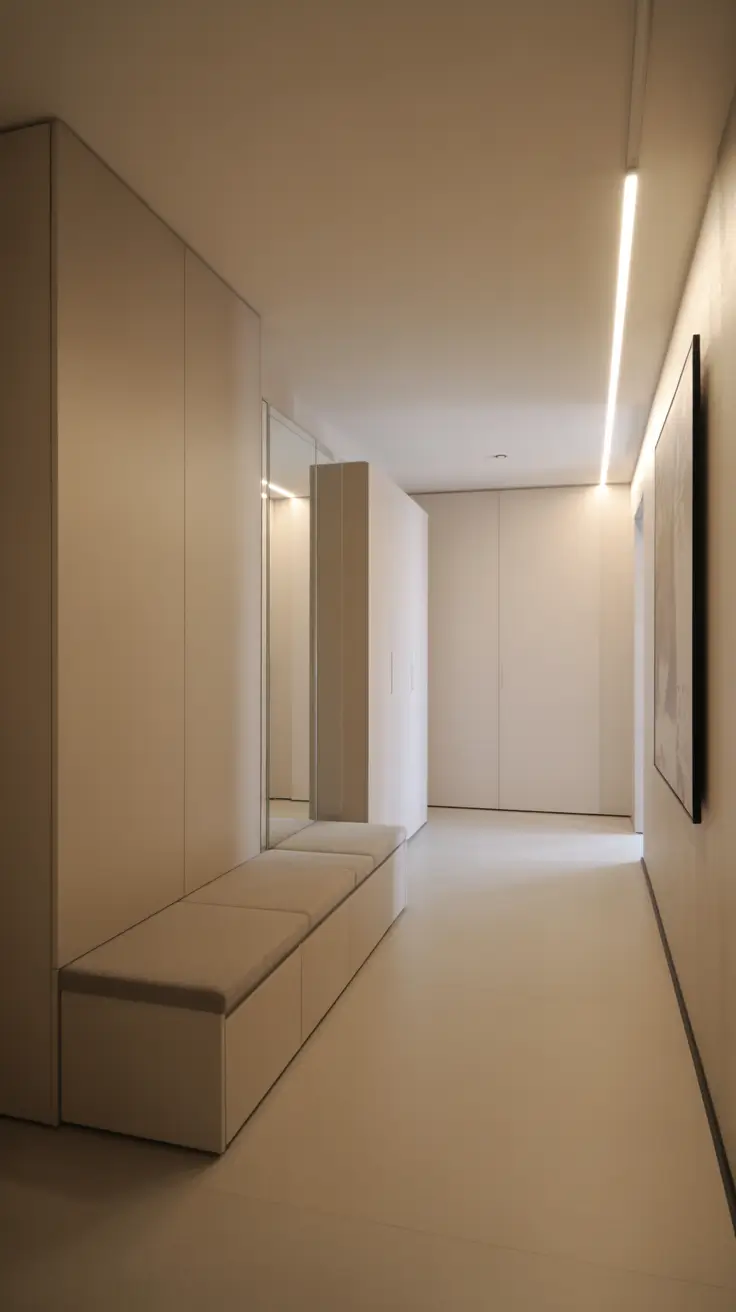
My rule of three ensures minimalist halls are not cold. I select three recurring items, including white oak, plaster, and linen, and replicate them in a predictable manner. I also maintain reveals very tight and consistent to ensure that each line is deliberate. Minimalism is all about organization, and I would have specific areas with keys, shoes, and mail entirely hidden. The end wall has one large work of art that is more impactful than a number of small frames.
I would supplement this approach with cable management and cleaning logistics that promote minimalism. I incorporate a charging drawer into the bench and a hidden docking niche with a robotic vacuum. When pets or children are involved in life I prefer to use washable runners and matte finish floor that conceals micro-scratches. These silent gestures render the appearance permanent rather than costly.
Lighting Innovations for a Brighter and More Inviting Hallway
I consider hallway lighting to be dynamic and stratified instead of a single ceiling lamp. Ambient lighting pre-establishes the foundation, art and texture is created by accent light, and guidance light ensures that night circulation is not a problem. In Long corridors, I will employ linear recessed fixtures or the use of small downlights spaced evenly to prevent scalloped patterns. On the Upstairs, I seek means of introducing daylight by skylight or a solar tube where building conditions permit. The wall colors with a mid to high light reflectance value make all lumens work harder.
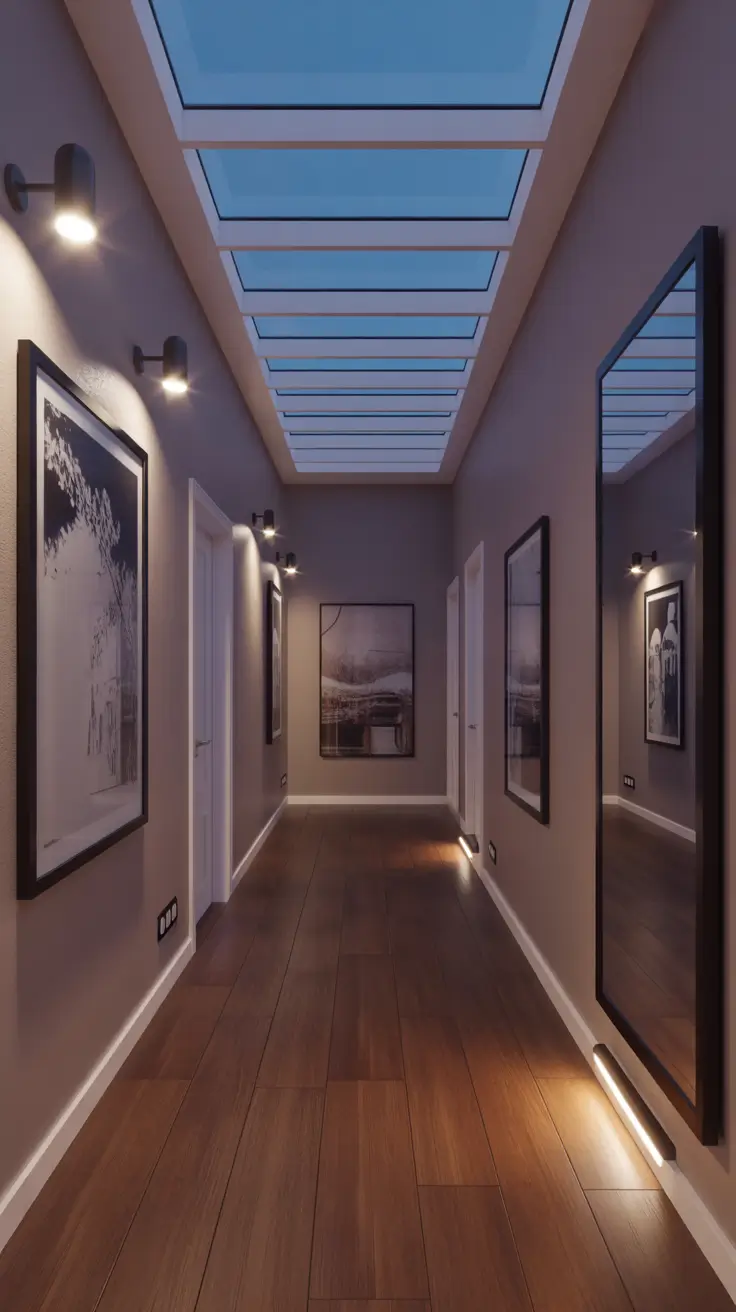
The fixture mix matters. The low profile ceiling lights offer even base light, and the wall washers emphasize art niches and texture. Eye-level slim sconces give a warm effect without reducing the width of the passage. On the floor, step or guide lights are sensor-activated to provide a safe night route. Mirrors that are positioned in front of a light system to reflect it increase brightness without necessarily increasing fixtures.
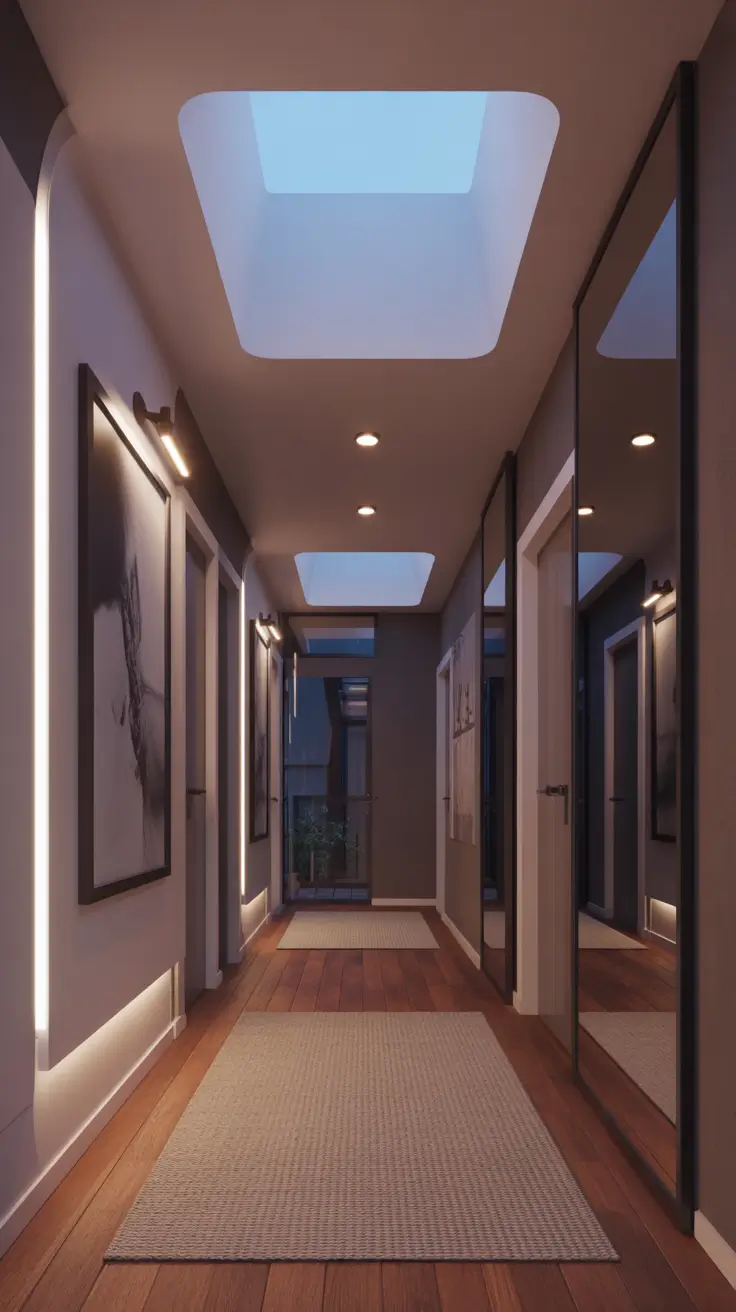
Personally, time-of-day color temperature adjustment of halls makes them look personalized and serene. Evening and day light are warmer and neutral respectively making colors true. I want to dim all your circuits so you can lower at night to avoid glare and brightness. Whereas in areas around the kids rooms or in guest areas, particularly the Upstairs, motion or vacancy sensors can be useful. A well-lit room will save you the effort of using brighter paint, and also allows you the chance of using much color.
To complete this plan, I would incorporate the use of smart switch locations at the end of every corridor, and in a place close to room door. By so doing, you can always get into or out of a Long hall with adjustable lighting. When you add a skylight you can think of a shade that can be used in managing the light in the bedrooms around. Lastly, prewire art lighting, though you may not actually hang anything the first day, the wiring is the easiest to install in the rough-in stage.
Flooring Upgrades That Define the Hallway Aesthetic
The flooring determines the mood and the flow of movement in a corridor. To visualize the space in small hallway remodel concepts, I use long planks or a herringbone pattern to give the illusion of expanding the space. In busy households, a hard engineered wood, luxury vinyl plank, or porcelain tile is the most durable and needs no more than a hose to clean. Acoustic underlayment in upstairs areas is to mute footsteps. When placing a bath in a location with thresholds, I would rather have a flush transition to avoid any tripping and to be able to clean with ease.
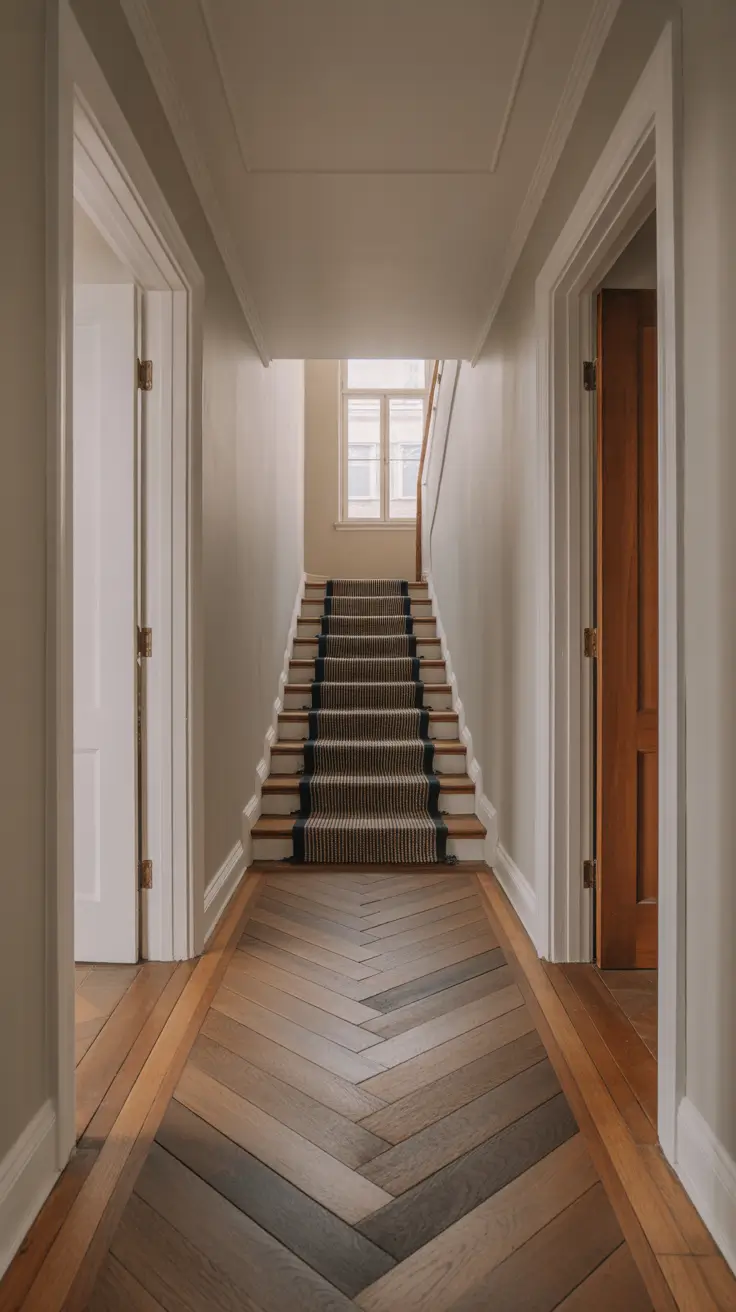
I construct the palette by construction. A medium toned floor floor is more effective in concealing dust as compared to very light or very dark and it also fills sound absorbing the finish. The stair nosing which is equivalent of the hall floor connects levels and appears purposeful. The run is framed by baseboards which are a just a little taller than the profile but do not draw attention to art or doors. In the cases where tile is used, I have the grout tones near the tile color to give a more relaxed interpretation.
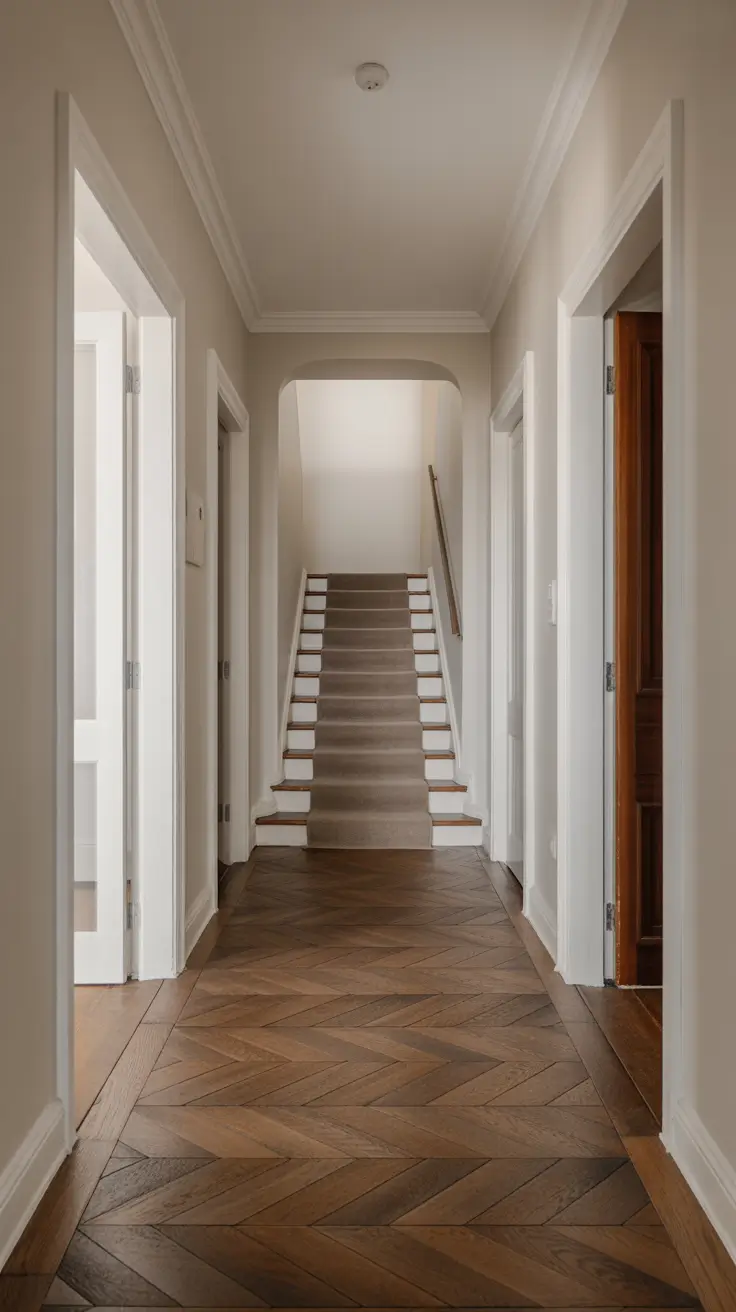
Pattern, in practice, is a potent device in Long layouts. The forward movement is pulled by a continuously running plank direction, or a herringbone angle that looks into the natural light. I prefer matte to glossy finishes because it covers micro-scratches and limits glare in bright light. When pets are included in the house, the texture assists in traction and conceals scuffs. Always add a quality pad to runners so that they do not slip.
The mindset that I tend to add is the maintenance. I will have a boot tray or mat area at the beginning of the corridor to receive grit. I also indicate touch-up kits to the wood color and corresponding caulk to the tile edges who are too small to fix up. In the case of Upstairs, I check the deflection limits and the underlayment specifications prior to tile to eliminate cracking. These measures ensure that the hallway appears new much longer.
Wall Treatments and Textures for a Dynamic Hallway Look
I begin with shaping the envelope of the corridor, since surface texture is important in the movement of light and the feeling of space within the corridor. To make small footprints look soft and cloudy to conceal scuffs and elevate even minor hallway remodel concepts, I apply smooth limewash or microcement. I use vertical slat walls, picture-frame molding or shallow board-and-batten to break the tunnel effect in long hallways, which often take advantage of rhythm. The spaces on the up-stairs may reflect those on the main floor, but I make the profiles thiner lest I crowd out the landing, and make it dangerous to walk across. To ensure that the ideas of a hallway bathroom remodel blend seamlessly with the rest of the house, I apply moisture-smart finishes on the initial part of the hallway after it leads to a bath.
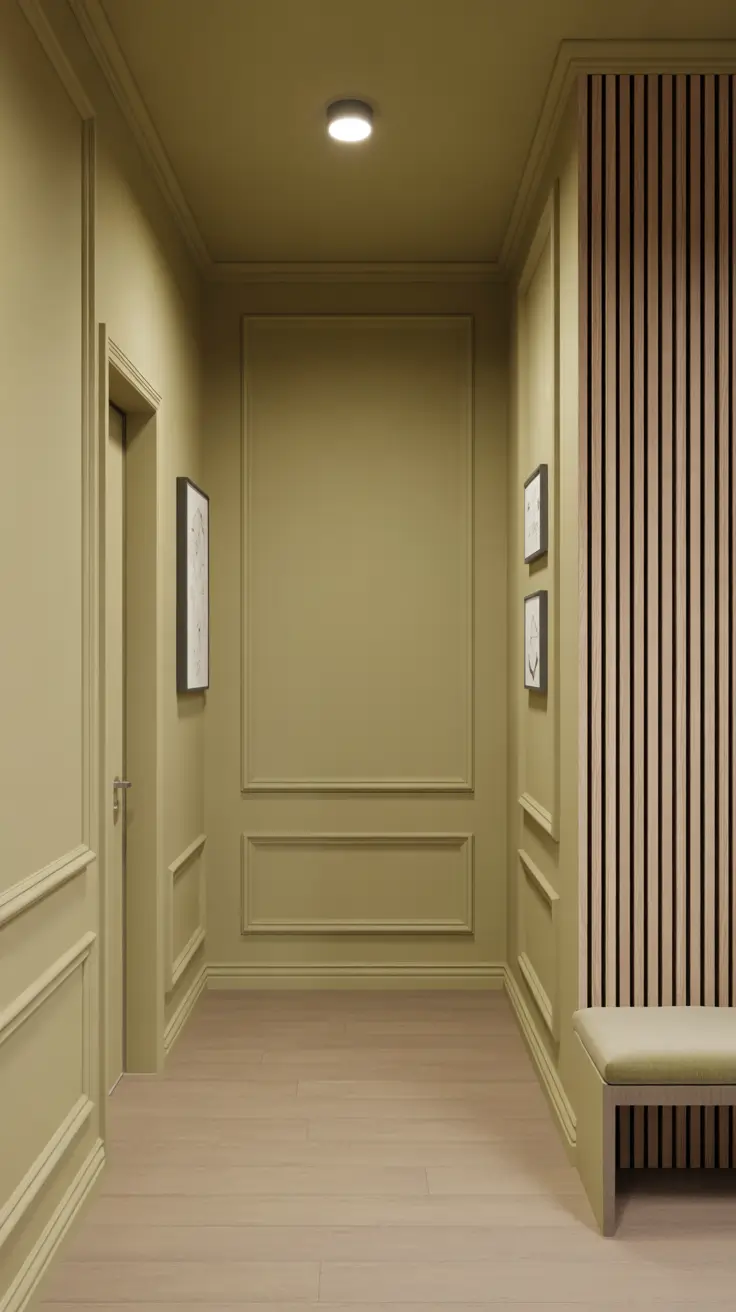
On the top wall, I prefer strong paint that I can scrub against and a touch-like treatment on the bottom. One side has a thin oak or walnut slat that does not steal width, and painted wainscoting gives high-traffic areas protection against backpacks and pets. I have found myself inclined to include a narrow picture rail on which to rotate an artwork and a simple chair rail on which to establish a two-tone scheme. Metal corner guards are polished to look like the rest of the hardware to make edges clean in family houses. In case of a nearby remodel ideas project of a hallway closet, I continue the same vernacular of trim language to the closet door to make it look custom built-in.
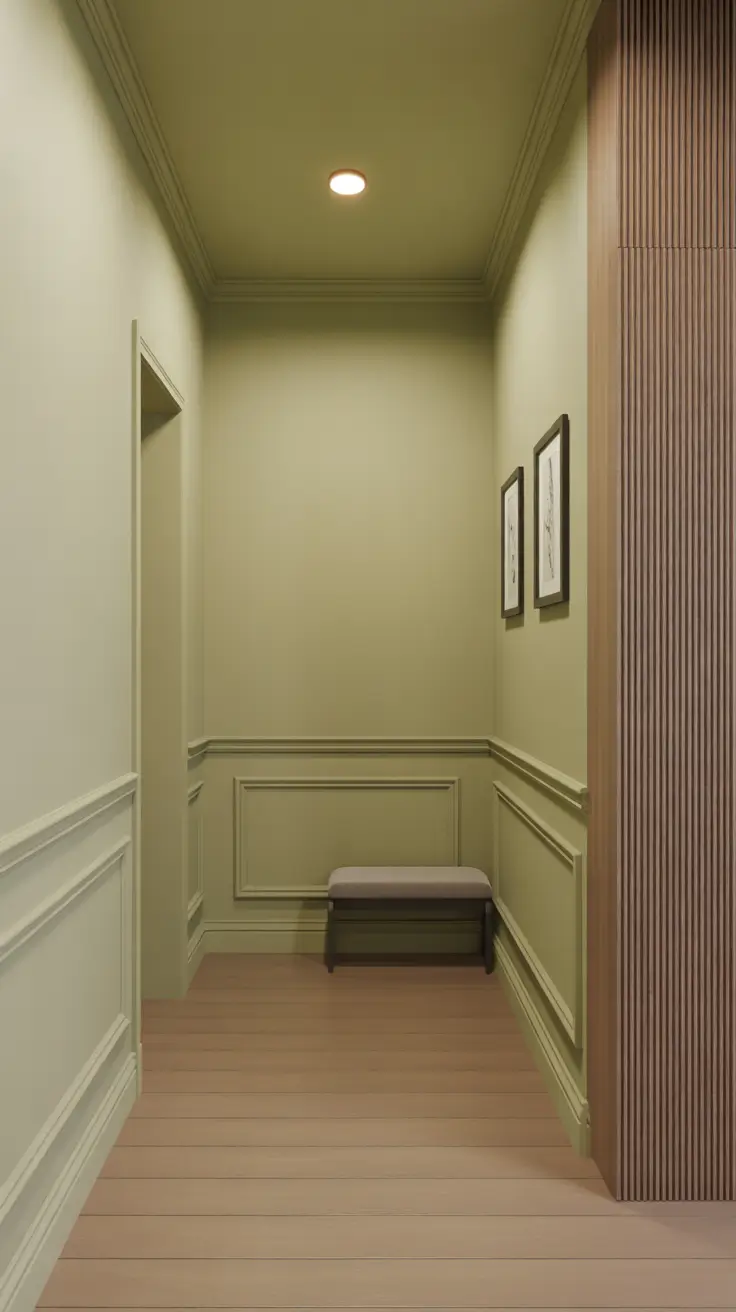
In my case, the space-maker is texture, and the color of the object does not suffice to create the space on its own. I sample a big sample board and examine it in day and evening to ensure that the finish is not blotchy under hot or cool bulbs. The most US design editors advise homeowners to think of sheen, and I do just that with eggshell or matte on the wall to ensure that the texture does not look shiny, but elegant. When a client desires high impact, I would concentrate on bolder profiles on one side and keep the other wall in calm to maintain movement balance.
To reinforce this area, I would include a basic ceiling treatment such as a small bead detail or a sharp shadow reveal and I would also upgrade baseboards and door casings to make the hallway seem deliberate all the way through the ceiling. It is a minor step that matches the vent covers and switch plates with the color of the wall that finishes the envelope.
Color Trends 2026: Painting Your Hallway for Mood and Flow
Color predetermines the emotional climate of circulation rooms, and therefore, I plan a palette that lets you move between the entrance and the living areas without sudden transitions. In the hallway remodel ideas 2026, I am seeing grounded neutrals, which are warmed by mineral undertones, and the confident accent at the end of the hallway terminus to draw you in. Long corridors are appreciative of a more intense color on the bottom wall and the more of a lighter value on the top to compress the proportions and then lift them. The coloring in stairsways is not similar as the daylight changes more during the day, and I prefer colors that appear consistent in mixed light. When a powder room or bath opens onto the corridor, I carry the hallway bathroom remodel ideas into the palette by using the same color of the door or the same color of the trim to create a unity.
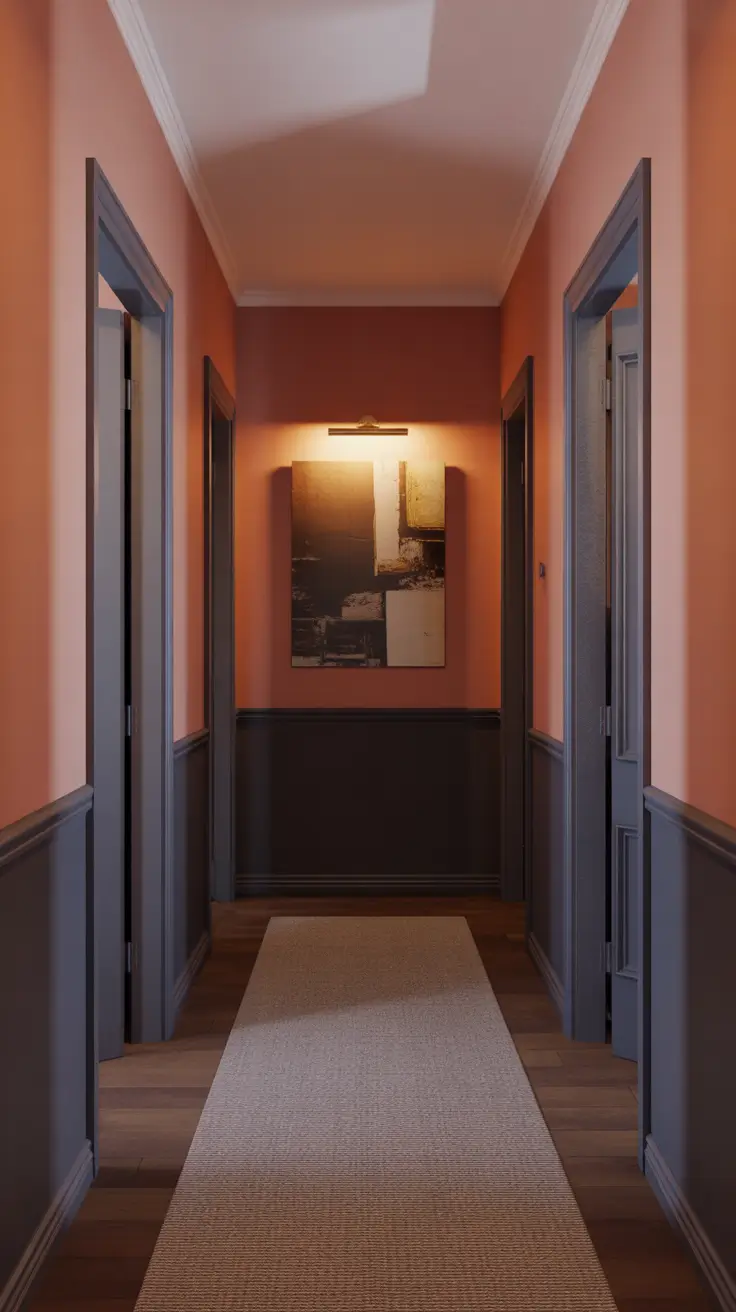
I define finishes by use. Touch marks on walls are covered in matte or eggshell, trim edges are sharpened in satin or semi-gloss, the door color is contrasting, but the difference is subtle enough that a boring run of doors becomes a design incident. To achieve a soothing tunnel of color that is nonetheless bright, I tend to paint the ceiling a shade lighter than the walls. At one end of the hall where there is a blank wall, I paint that wall of a deeper colour, and still another picture-light, and on that wall one great piece to form a goal. To remodel hallway ideas in small areas, solid color on doors, trim and wall removes visual disturbance that makes the corridor appear broader.
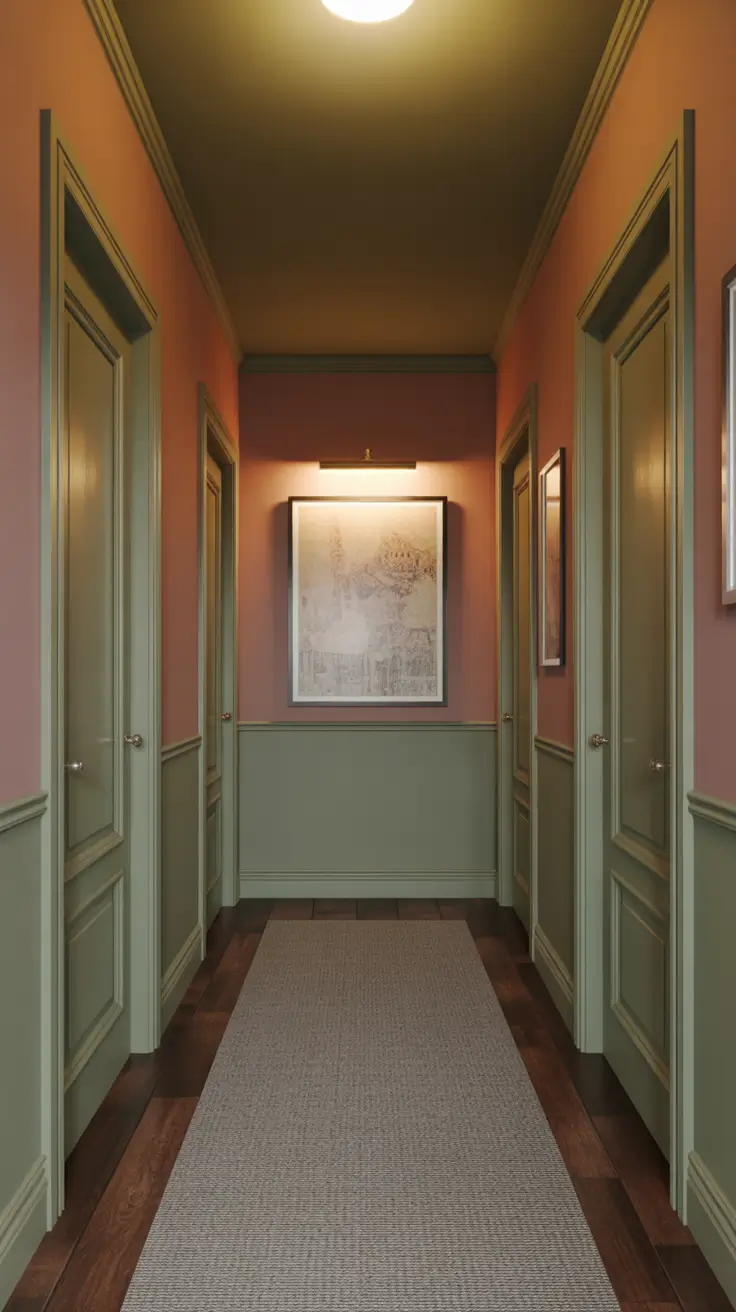
After years of experimentation I have discovered that I can judge colors based on light-reflection and no longer just by name. I never pick up more than two or three candidates and hold them up against the floor and trim since undertones change against oak or tile. The most popular advice that I found in the publications of the US includes the idea to test paint at night, using your own bulbs, and I do it, testing warmer and colder colors to make sure the hallway is comfortable after the sun goes down. In case of uncertainty, I prefer a neutral and one that is not very straightforward but looks pleasantly in between seasons.
What I would have to this is a stairwell and landing transition plan. I prefer repeating the wall color on the stair stringer or the handrail accent up and down so the eye follows one continuous line and I chart the location of the color discontinuity at corners to eliminate sharp edges on the return walls.
Storage Solutions for a Functional and Organized Hallway
A corridor is also effective when it stores what you require without robbing comfort to the pass through area. My ideas on hallway closets remodel involve turning dead space into shallow, high efficiency space with a flush, door mounted deep and hardware avoiding snaring of clothes. To the family members, I would put a small bench that has an extra compartment so that shoes and other seasonal accessories are gone within a short period. The design ideas of small hallway remodeling frequently depend on vertical space, and I fit a narrow upper cabinet run or a clean peg rail, rather than large freestanding ones. Long corridors may accommodate a row of recessed key, mail and display niches to ensure that the walkway remains open.
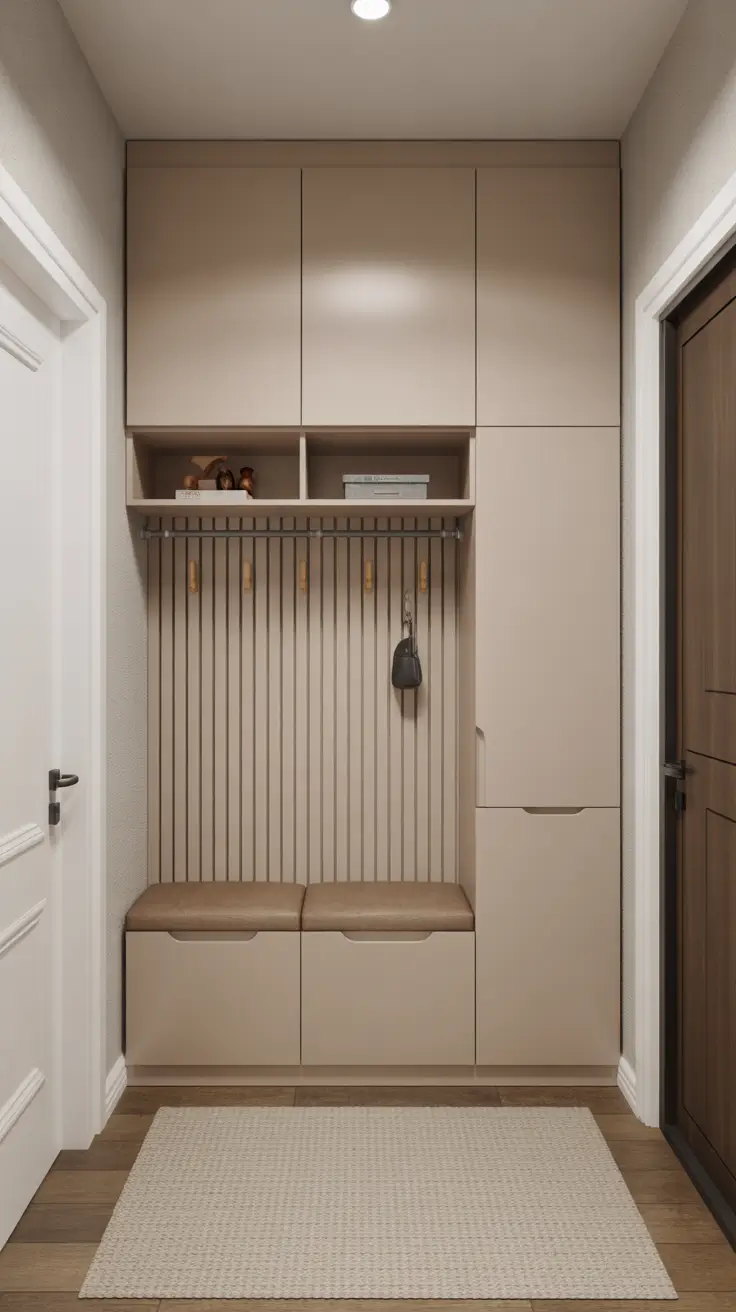
The items I have identified are smooth and diligent. The drop zone is anchored by a thin bench with a lift top to allow the floor to be seen. Shoes, hats, and baskets are better placed on tall, shallow cabinets that have adjustable shelves as opposed to lost on deep shelves. I include a phone and earbuds charging drawer, and I recess a metal umbrella shelf to ensure that no drippies fall on the floor. The built-ins are custom-feeling soft-close concealed hinges, low-profile pulls, and a durable top surface, and there is no visual clutter. Provided the hall is in contact with a bath, I might design a linen niche that would allow hallway bathroom remodel ideas to have additional storage without cramming the vanity.
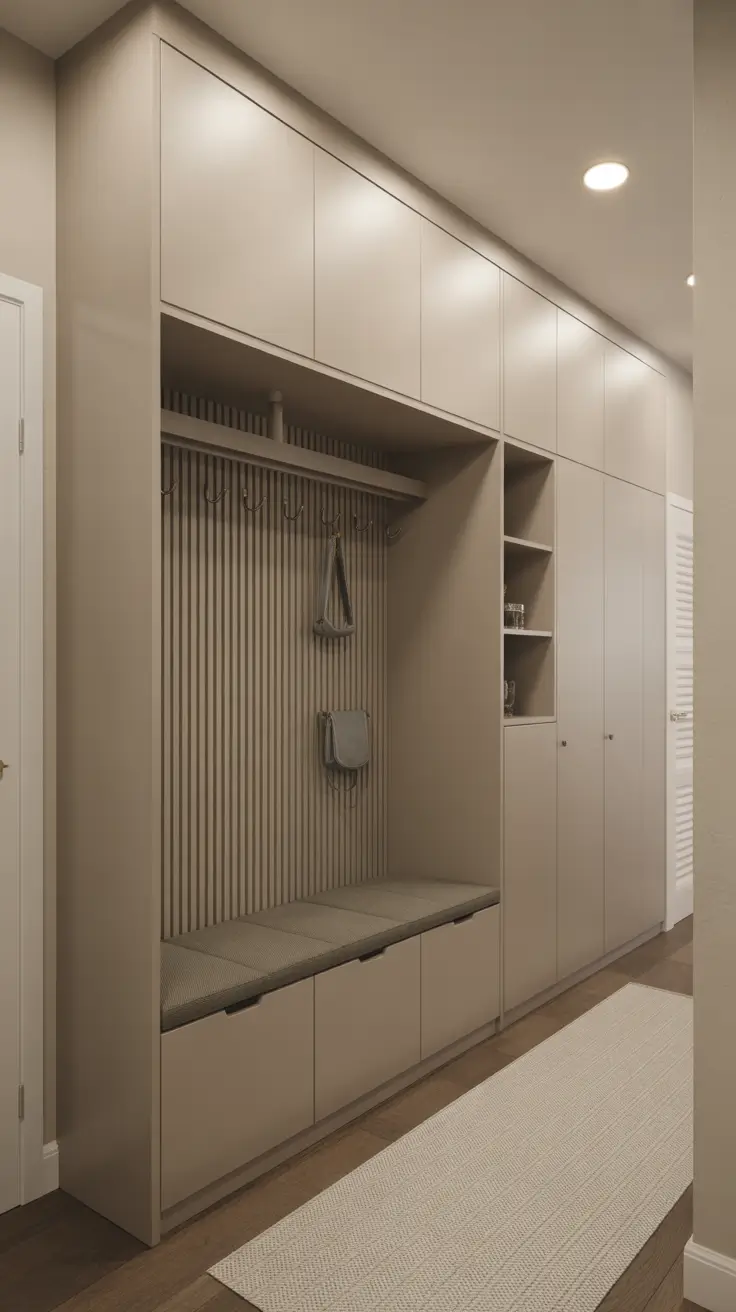
Practically, I realize that clutters multiply in the transitional zones hence I design boundaries. I give the family members each a cubby or a basket and label it. I maintain the number of hooks to an optimum level to avoid congestion and loss of eye line. I also make sure doors open completely without crowding movement and in tight spaces I take into consideration a pocket or clean-lined bifold to reclaim space. Once the projects become complicated, I consult the local code mandates regarding the location of egress and smoke detectors to ensure that safety is not put at risk because of the storage.
To complete this plan, I would include built-in lighting, and motion-activated toe-kick lights on the built-ins, shoe shelves that are ventilated and a washable runner in front of the drop zone to increase the life span of the finishes as well as make the maintenance easy.
Incorporating Art and Decor in Hallway Remodels
Art transforms a passage into a gallery of one’s own, and proportion is all. I will have one, powerful focal wall on long hallway remodel concepts and leave the rest of walls relaxed so that the facility does not appear cluttered. Mirrors enhance the amount of light and make narrow halls appear broader, particularly facing a window or a sunny doorway. I like framed prints on one side only upstairs, as stair already creates visual dynamism. In residential construction where a bathroom door opens onto the hall, I put an eye-catcher next to the door and not on the door, which makes hallway bathroom remodel ideas graceful and down-to-earth.
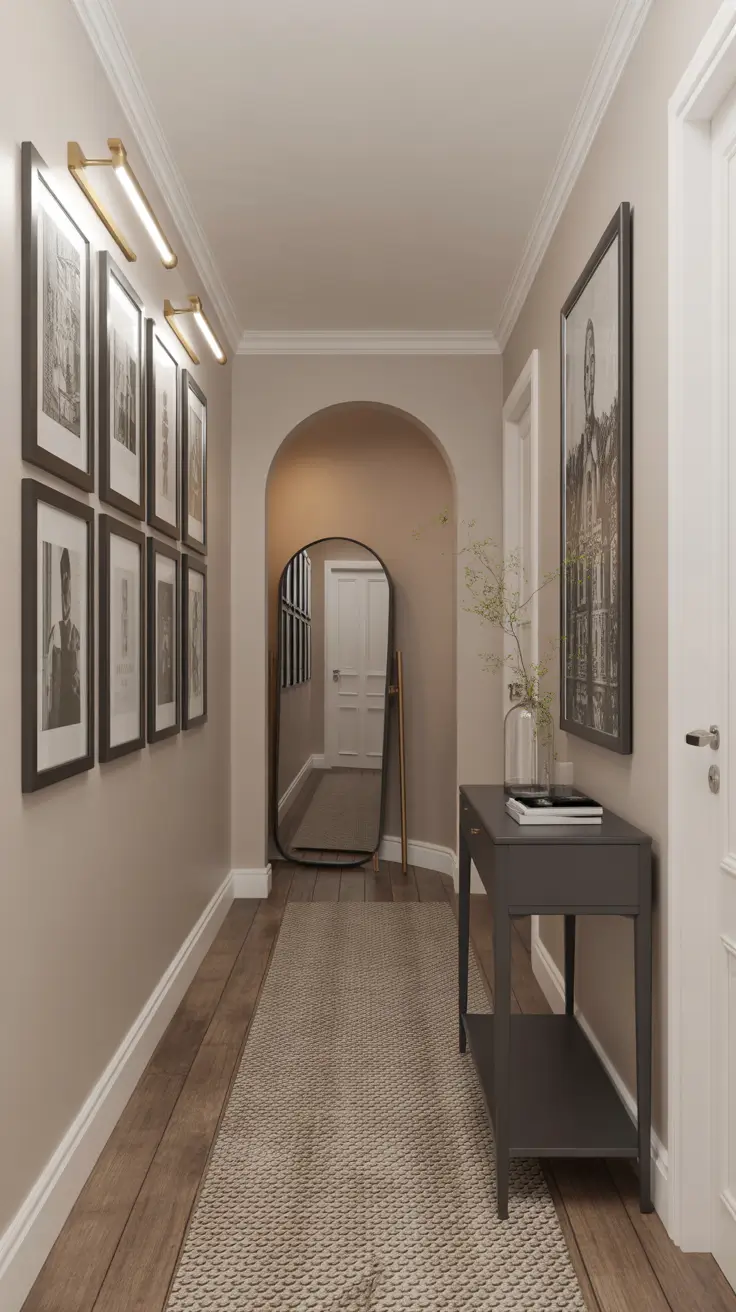
I have a few reliable decor items. A low-profile picture ledge allows rotating the art without drilling new holes, and a linear picture light attracts attention exactly where you need it. A large floor mirror towards the terminus of a hall gives the impression of a depth and a quick check-out area. A tactile runner dampens sound and directs the eye forward and a single-drawer slim console not crowding the way picks up keys. In the case of family houses, a peg rail will serve as a display of hats or woven totes as well hence decor is also storage.
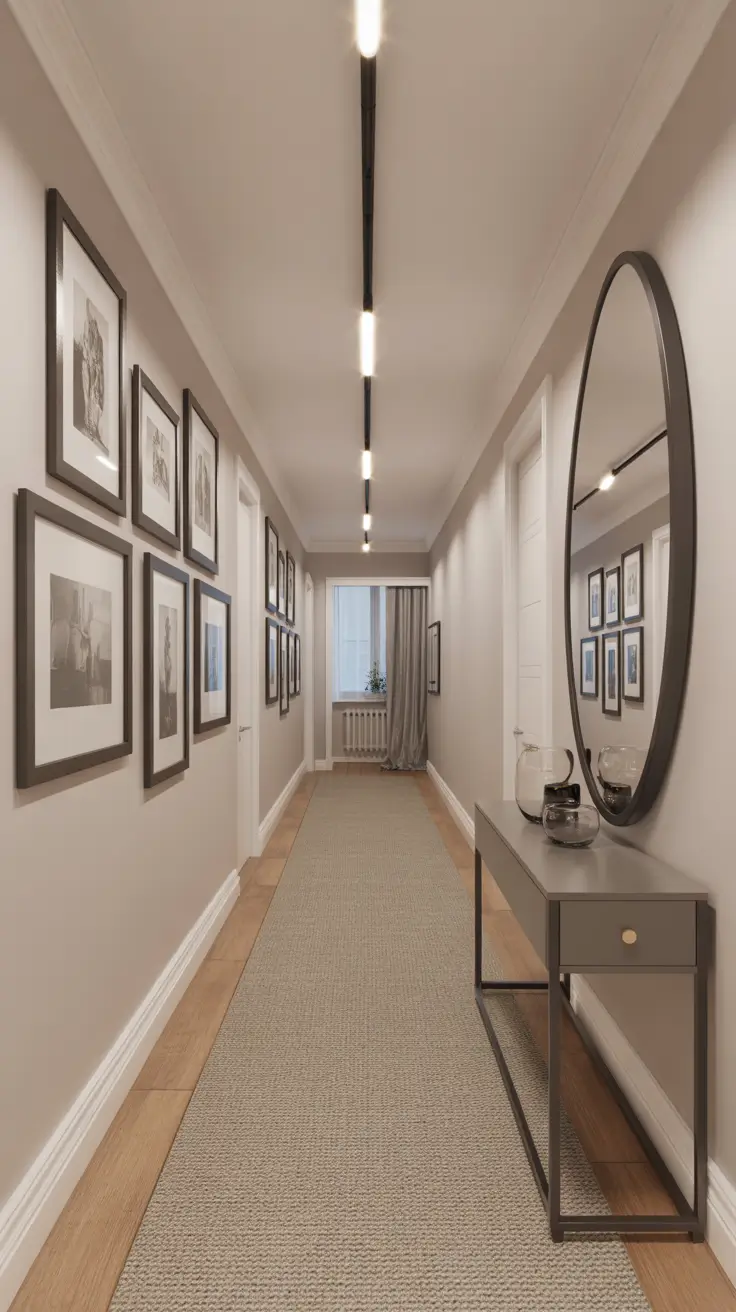
I have the saying consistency is better than quantity. I maintain frame finishes to two of them, match tops to create a nice horizon, and hang them at a friendly eye level to ensure the hallway provides the read of a serene passage. Museum professionals tend to suggest regular spacing and glare, so I select non-glare glazing and do not place art directly opposite of a bright window. Dimmable picture lighting or moveable track lights allow me to refine highlights in the evening, and art does not feel flat.
To improve this area, I would include sound-absorbing attributes such as a cloth runner with a thick pad and some upholstered ottomans in bigger landings. In case the hall is direct sunshine, I would indicate UV-filter glazing that secures textiles and prints.
Eco-Friendly Hallway Remodel Ideas for Sustainable Living
The beginning of a sustainable corridor is materials that are durable and finishes that make indoor air healthy. I use low-VOC paints, FSC-certified woods, and runners made of natural fibers, which are simple to wash and change. In cases of upstairs hallway remodel, daylight may be your friend so I paint the walls of the day, employ a reflective mirror and an effective skylight tunnel whenever possible. Long spaces have wall bases and corner details that are not fragile to chipping hence replacement is uncommon. Bath or laundry doors opening to the hall will be closed by me, and moisture-smart finishes are specified to ensure that the remodel ideas of hallway bathrooms are healthy and mold resistant.
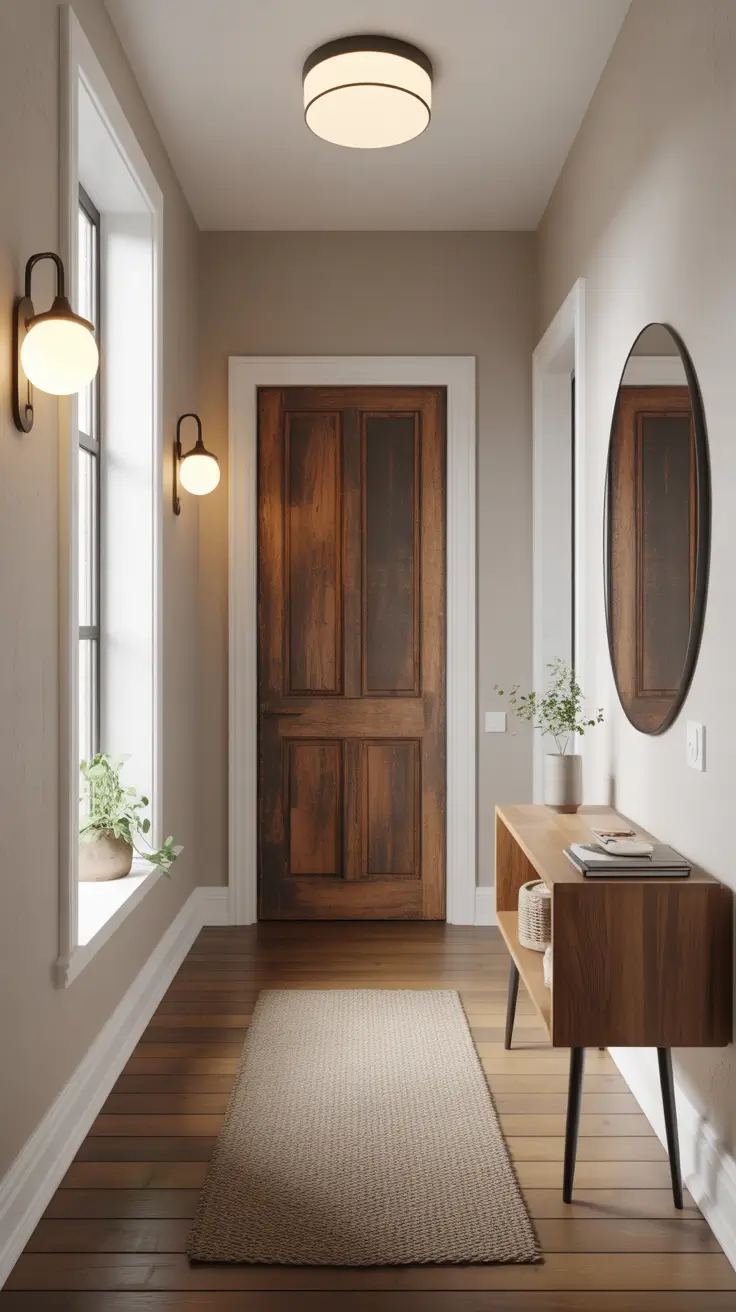
My fixtures and furniture are hard working and energy sipping. The LED sconces are motion-sensors and have a minimalist flush mount which ensures that the level of light used is not wasted. Rechargeable picture lights do not require wiring and reduce energy consumption, and a smart dimmer can be programmed to turn down light later at night. Consoles and door slabs made of reclaimed wood introduce character without extracting new resources. It is controlled by natural plasters that control the humidity and runners made of wool or jute which provide texture and are also biodegradable. To store, I would use powder-coated metal hooks and handles that are rust resistant and can last many years.
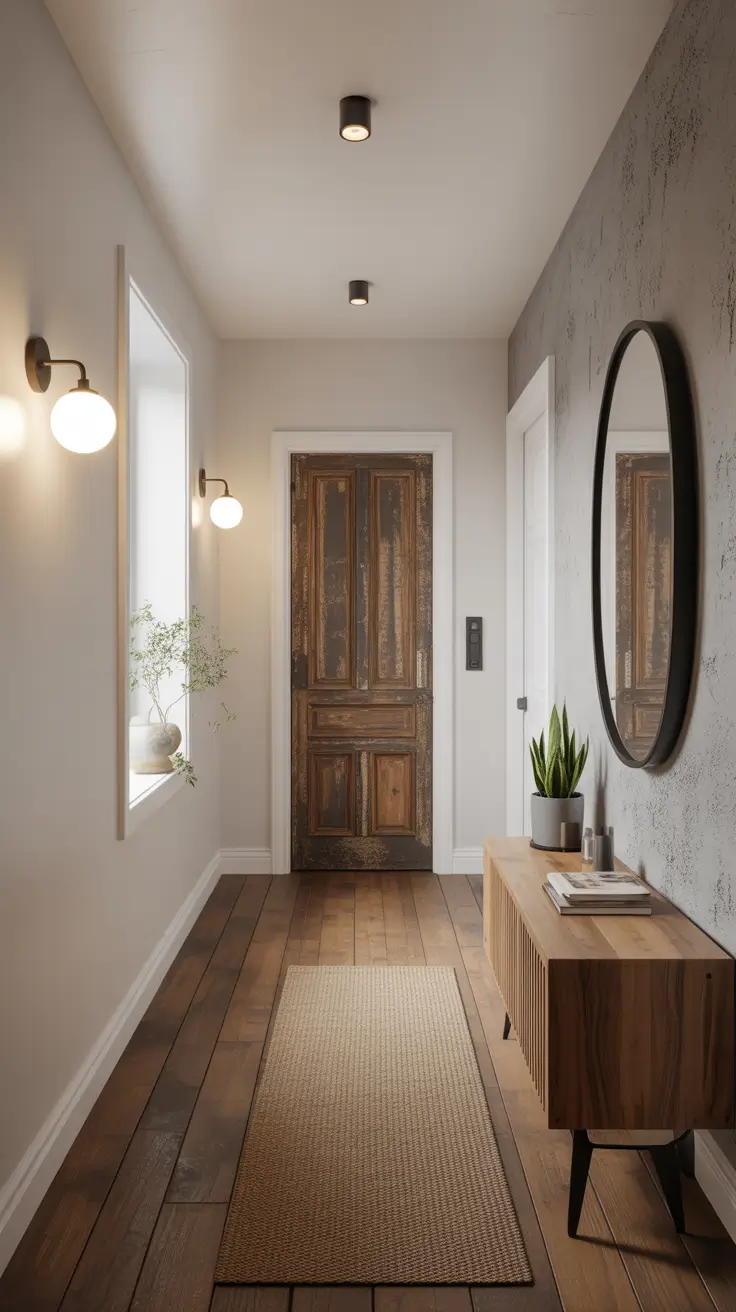
I also put a strong emphasis on trends as opposed to lifecycle thinking. Wearing paints and worn out profiles are minimized, and antique profiles do not require replacing. The health and environment resources in the US focus a lot on ventilation and products that emit less, and therefore, I will select paints and adhesives with confirmed emissions data and make sure to make sure that the air circulates well. I also prefer modular runners that can be washed or changed without the need to pull up new tack strips, reducing waste.
To fill this section, I would include a plant-friendly zone, a small ledge close to a window or growth friendly sconce, and a basic recycling station near the entrance to collect mail and packaging before they travel further in the house. Finishes are safeguarded by a maintenance program using mild cleaners and is in line with the sustainable purpose.
Tech-Savvy Hallways: Smart Lighting and Digital Design Trends
I go into a hallway, which is technically progressive, but I think of it more as a stage that shifts with the time of the day and usage. The lighting is layered at the back with a dimmable ceiling lamp, toe kick or baseboard motion activated LEDs, and slender sconces that illuminate the walls to minimise glare. I include a small smart screen or in-frame computerized art at a natural stopping point to ensure that the hallway does not get too crowded. When the hallway moves into bedrooms, I will program the night scenes to light warmly but at minimum as I do not want to break sleep cycles. I also intend to create a clean technology area with concealed cable routes and access door to ensure that maintenance will not involve any opening of walls. The outcome is a calm, future-proofed corridor that cannot be deprived of feeling warm and domestic.
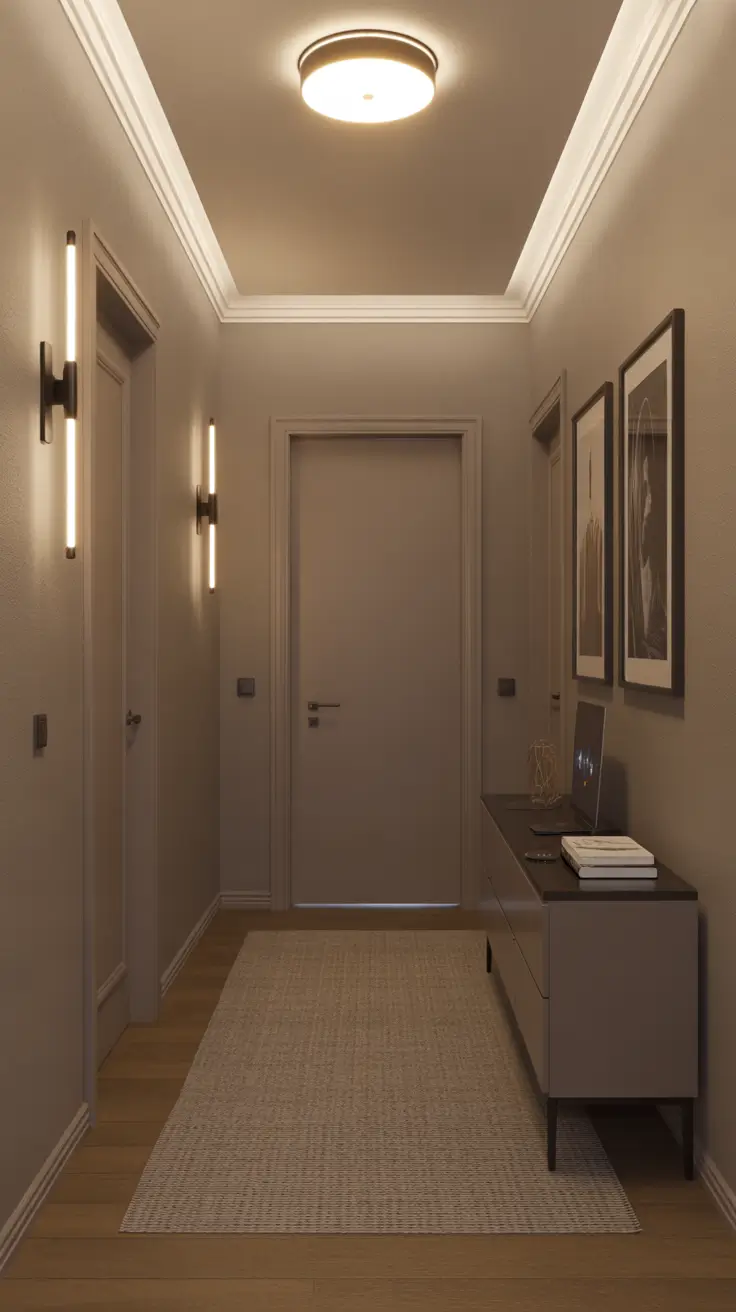
In case of fixtures, I prefer a low profile flush installation with continuous strips of LEDs fitted to a shallow reveal at the bottom of the baseboard. I make sconces that have closed tops to evade ceiling scallops and sconces that have tunable-white bulbs so the color temperature can vary between bright work and evening amber. There is a narrow wireless-charging drawer of phones and keys, and a magnetic wall rail that stores small devices or earbuds. I use a non-shiny paint with a low sheen, which does not hotspot when viewed through a grazing light, and I place gallery tracks on the walls of art to run digital frames without drawing attention. Each end has a smart sensor that turns on lights in sequence to ensure the hall directs movement as opposed to shocking it.
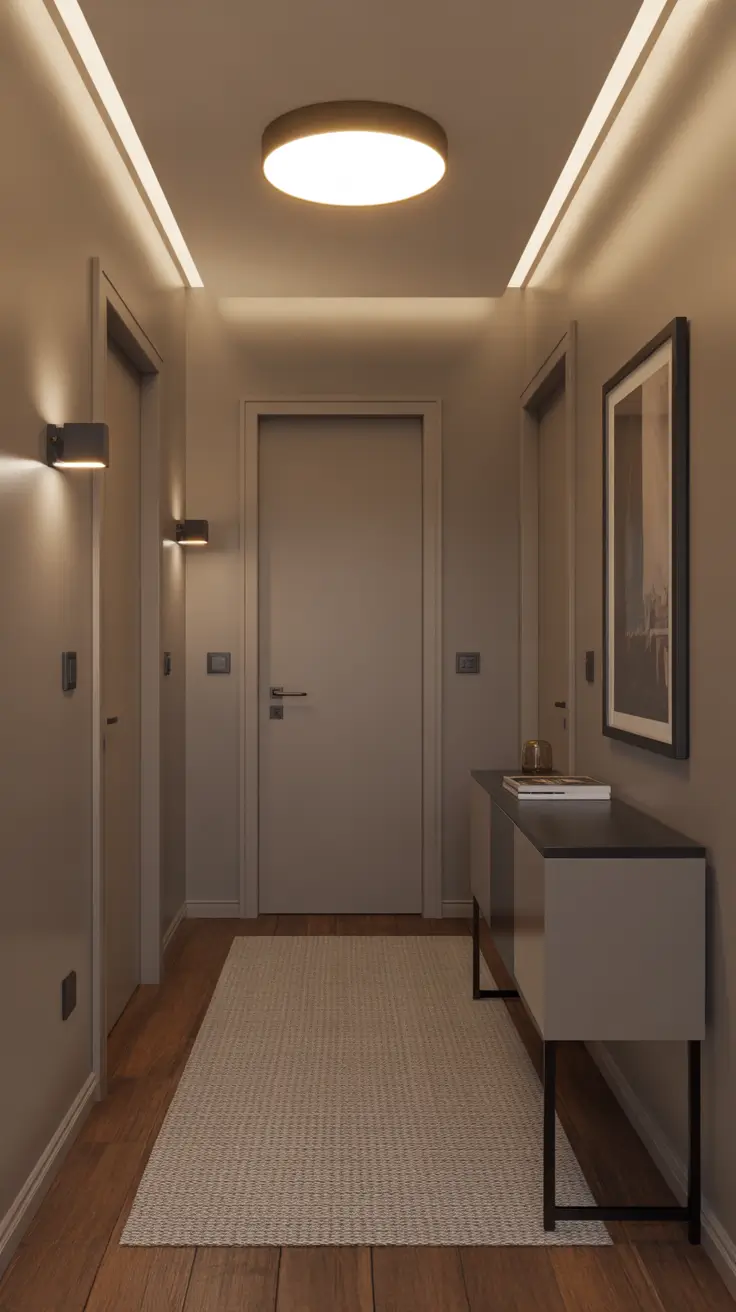
Scene control which matches motion with time-based overrides is the largest win in my experience. In US publications, lighting designers and sleeping specialists tend to suggest that warmer color temperatures should be used towards the end of the evening, and I adhere to it by limiting night scenes to warm white and low lumen level. I also plot floors reflectance to light levels to keep glare in check and this is particularly good on long runs where bright bulbs may tend to give the tunnel effect. I have voice control enabled but not mandatory because guests are quicker with the buttons with clear labels. It aims at convenience without making the space look like a shelf of gadgets.
The things that I would add here would be acoustic softening, as smart halls are prone to echo. I would introduce a runner with an underlay, a few upholstered wall panels masquerading as art or felt under the console to cut down the pickup of the mics and enhance intelligibility. I would also mention a small niche with the power outlet that is large enough to fit a smart speaker, leaving the surfaces clean and cables hidden.
Budget-Friendly Hallway Remodel Ideas That Impress
In situations where I am operating under a strict budget, I will focus on three tools that transform a hallway quickly: light, color, and storage discipline. I begin by repainting in a soft neutral high reflectance to bounce available light, then I update the ceiling light with a basic dimmable. To make touchpoints feel new, I upgrade hardware on any built-in doors, and I also add a runner to balance the visual proportions. To create a mini gallery that is easy to rotate without any carpentry, I attach peel-and-stick picture ledges or a slender rail to the wall. Lastly, I adjust the layout such that traffic passes through it as the most luxurious view you can have without spending money is a clear path.
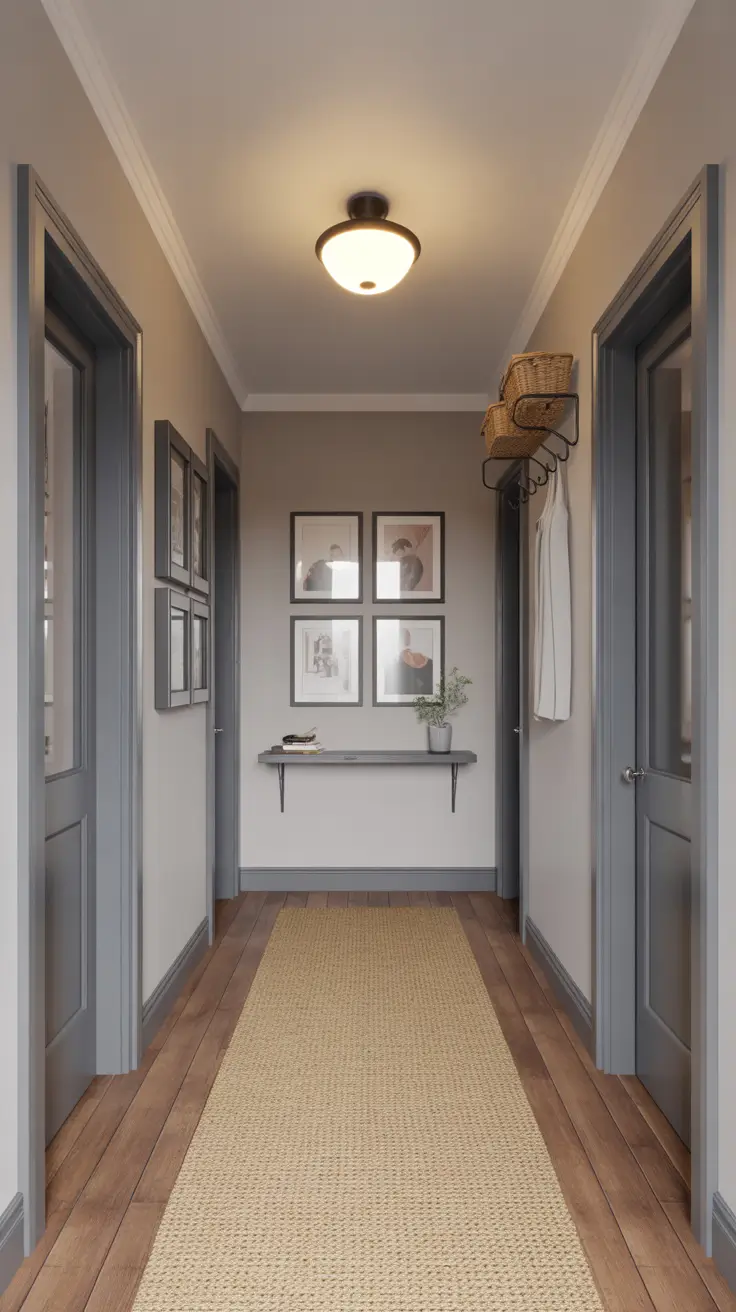
On items, I use a flush or semi-flush ceiling light with white diffuser, two or four picture ledges, gridded on the wall, and a removable washable runner, running almost floor to floor. A narrow console I tend to add to it only when the hall is broad, otherwise I replace a shallow shelf by brackets concealed. I have one hook rail across the door, and I have baskets in a single color and standardize them to create visual calm. Fingerprints are often concealed by painting the door more deeply than the walls to provide depth, and hinges and levers are changed to a single finish to give a unified look. The little improvements that could be made such as soft-close bumpers on the door and pads of felt beneath the baskets are able to avoid the little sounds that allow a low-priced hall to look and feel like a bad knockoff.
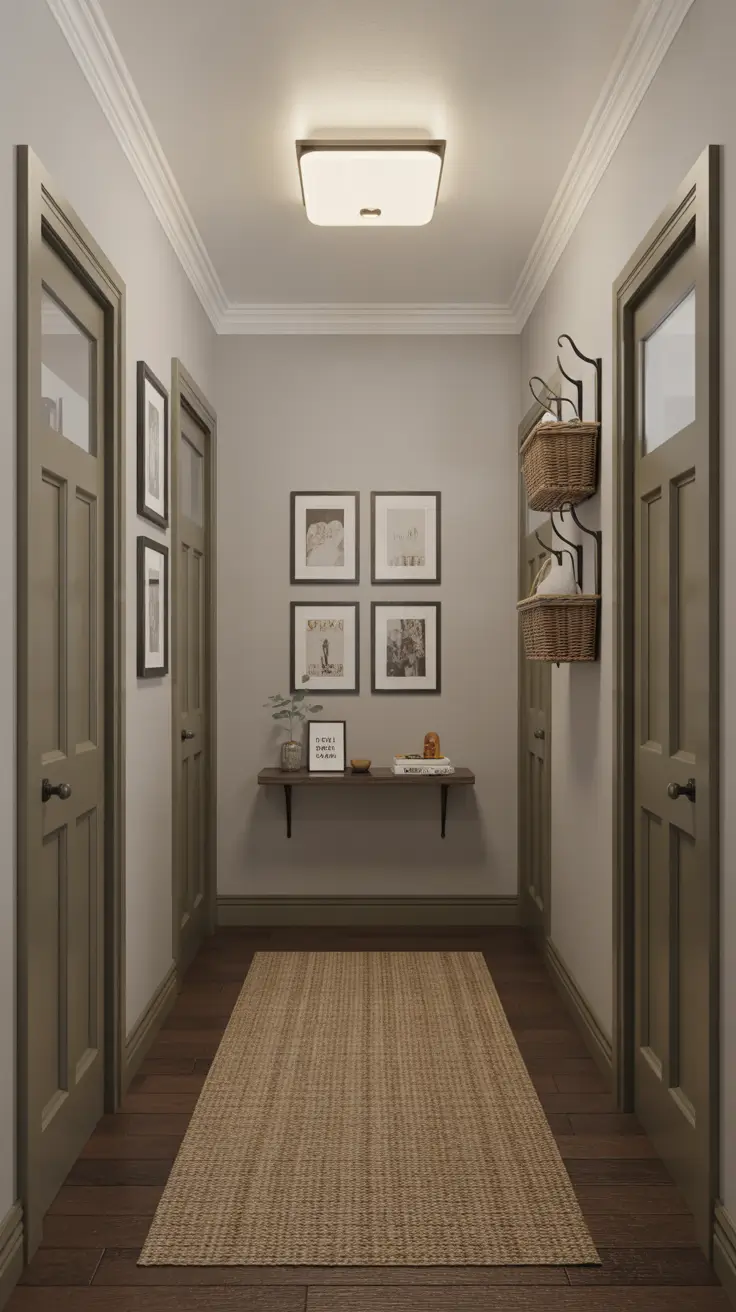
As practice has shown, paint finish is much more important than most individuals assume and most US paint experts recommend either eggshell or satin in corridors to allow wipeability without glare. I do not use a lot of gloss on long corridors since it reflects all the light points and may leave the walls uneven. I also feel that replicating a single warm metallic finish on lights and hardware is deliberate even with entry-level items. In case a client desires pattern, I place it on the runner prints or the framed prints, but not on the wall, to ensure the ease of touch up.
What I would include to this budget set is a small refresh plan on doors and trim. I would establish a schedule over the weekend, which involves caulking hairline cracks, sanding scuff marks, and repainting trim first, then doors, and then walls. Another pre-planning I would consider is the size of art that should not be swiss-cheese walls, as I would use paper templates to draw something prior to sticking it on the wall.
Final Touches: Styling Your Hallway for a Lasting First Impression
Finally, I am polishing proportion, texture and rhythm to make the hallway a designed room and not a pass through. I monitor vistas between rooms and so you will find there is something purposeful on both sides. I include greenery that can withstand low light, such as a shaded plant atop a stool in a dead end or a high branch in a floor vase where there is space to allow a width. The mirrors are positioned facing the sources of light to raise the brightness and I do not face them directly to each other to create an infinite increase of reflections. I conclude with a runner which supports the way and a unifying group of frames which strides down the wall on the eye level. It should be inviting whenever you come back.
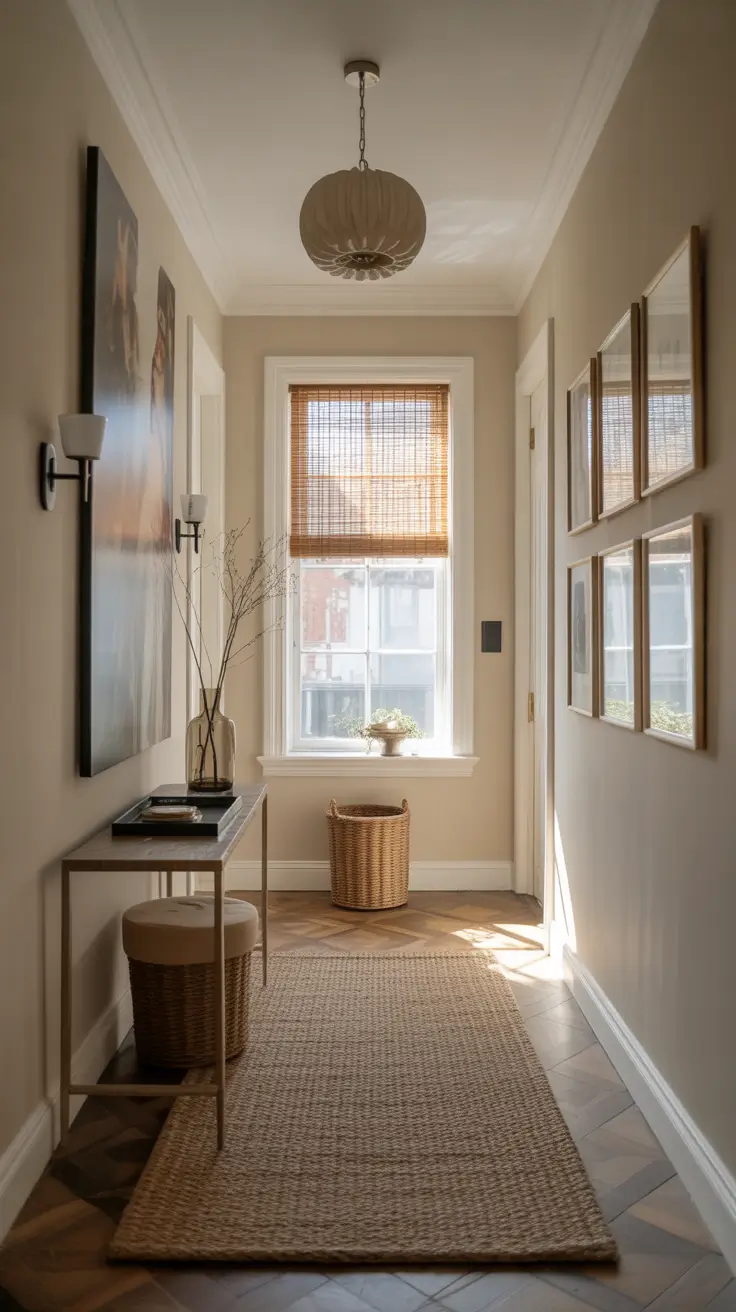
To decorate, I request one large-scale artwork or online frame at the entrance, two small sconces to make it flanking, and a slender umbrella stand or sculptural basket at the baseboard. I would prefer one touchy feature like a ribbed ceramic vase, and a natural fabric runner with a faint pattern to conceal the wear. Keys and mail are collected in a shallow tray on a console, and stored in closed bins within the hall when on a console in front of the front door, or in the storage area in closed bins when the hall is occupied. In case there is a hallway closet, I align interior hangers and boxes with the visible palette to make it not interrupt the mood on opening the door. The blend of materials is warm and durable such that touchpoints gracefully age.
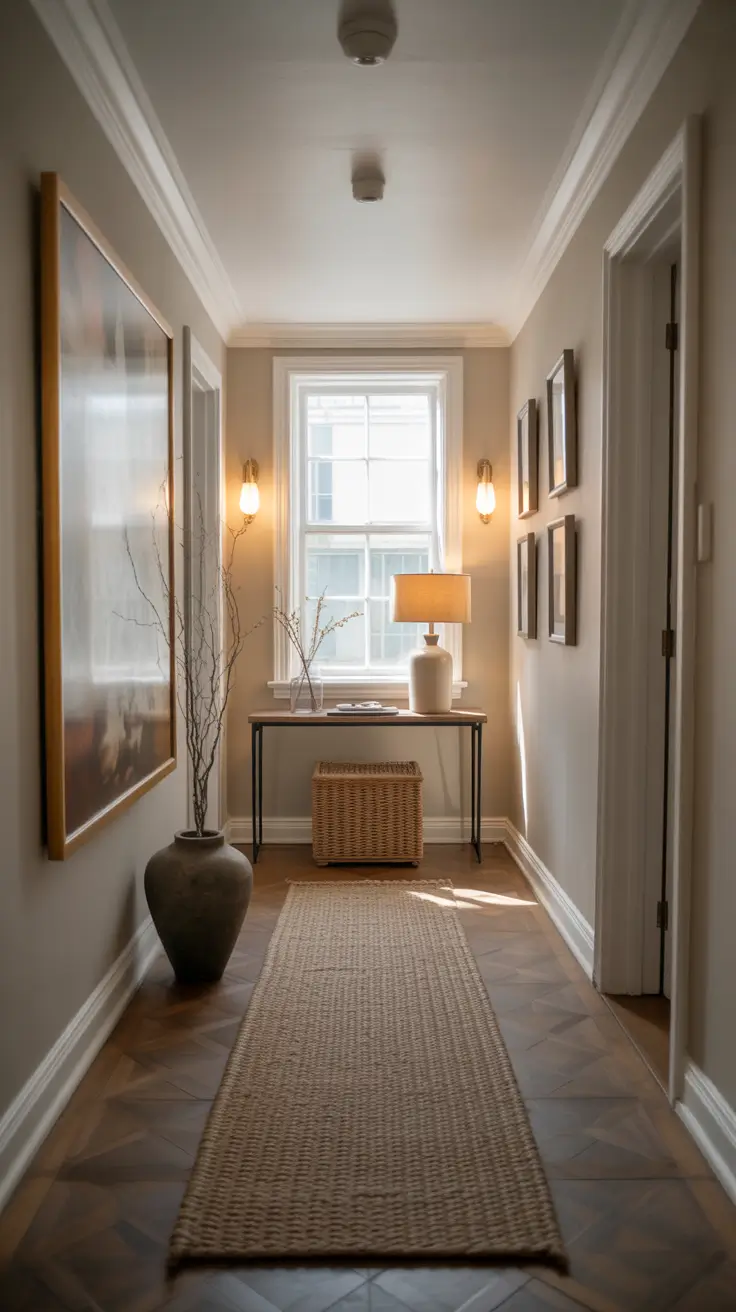
I think a well-dressed hallway is borrowing the visual merchandising tricks of retail used by most US home stores: repeat a shape, change scale, and maintain color to a narrow range. I tend to choose a single accent color that is already present in another room nearby to make the transition look more natural. I maintain consistency in plant vessels and frames and leave the interest to the texture. Mirrors must be hung to reflect something pleasing such as a window or art and not an empty door. Here the most minor changes are rewarded.
I would be inserting smell and sound as glazes. I would have a small reed diffuser on a high shelf with little hands, and I would put felt bumpers on frames to avoid the rattling noise when closing the door. I would also pre-cut spare runner pads, label art hanging hardware in a small kit and write touch-up paint codes in the inside of the closet to make future maintenance easy.